Download
1 / 8
80 likes | 188 Vues
A 24-year-old male presented with an insidious onset of knee pain persisting for 6 weeks and nocturnal discomfort. The differential diagnosis included pes anserine bursitis vs. osseous lesions. Imaging revealed a multi-lobulated lytic lesion in the proximal tibia, well-defined in some areas but irregular in others. MRI confirmed low signal intensity on T1 and high signal intensity on T2-weighted images, with significant bone marrow edema. Abnormal laboratory results indicated elevated CRP and ESR. The case was identified as Brodie's abscess, and the patient was referred to an orthopaedic surgeon for management.

E N D
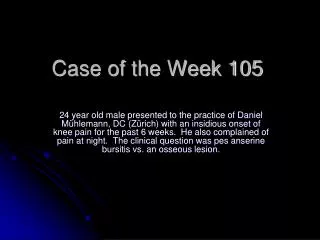
Case of the Week 105 24 year old male presented to the practice of Daniel Mühlemann, DC (Zürich) with an insidious onset of knee pain for the past 6 weeks. He also complained of pain at night. The clinical question was pes anserine bursitis vs. an osseous lesion.
What are the abnormal findings? What is the DDX? What should be done next?
Answers • Abnormal findings: • There is a multi-lobulated lytic lesion in the proximal metaphysis of the tibia. In places it is well marginated (superiorly) while in others the borders are not that sharp. The cortex is intact, there is no periosteal reaction and no soft tissue mass. • DDX: • Brodies abscess vs. Giant Cell Tumour (GCT) vs. Aneurysmal bone cyst (ABC) vs. low-grade Osteosarcoma. However, a GCT typically extends into the epiphysis to the articular surface and an ABC is very expansile. • What should be done next? • Laboratory evaluation and MRI.
MRI slices (and on next slide) T1 Coronal slice T1 axial slice Contrast Enhanced fat supressed axial slice
What are the abnormal findings? What is the likely Diagnosis? Contrast enhanced fat suppressed sagittal slice T 2 weighted sagittal slices
Answers • Abnormal findings: • The multi-lobulated lesion previously noted appears well marginated on the MRI slices and is low signal intensity on T1 with high signal on T2 weighted images. • It enhances with contrast, particularly the border. • Bone marrow edema is noted surrounding the lesion (low signal on T1 and high signal on the contrast enhanced fat suppressed slices). • Contrast enhancement of the soft tissues anterior and medial to the proximal tibia is noted. • Likely Diagnosis: • Brodies Abscess.
Laboratory Results • A CBC (complete blood count), Alkaline Phosphatase, LDH, and C-Reactive protein (CRP) were ordered. • The only abnormalities found were: • CRP = 28 mg/l (normal is up to 5) • ESR (sedimentation rate) = 36 mm/h (normal is up to 8) • The WBC along with the differential were within normal limits.
Follow Up • The patient was referred to an Orthopaedic surgeon. • This was a proven case of Brodies abscess.