Understanding Linear and Exponential Models in Real-World Applications
This unit focuses on utilizing real-world situations to construct, compare, and solve problems using linear and exponential models. Students will explore how to determine whether an exponential function represents growth or decay. Key concepts include transformations of exponential functions, graphing techniques, and identifying properties such as domain, range, and asymptotes. Through practical examples, learners will gain insight into the behavior of exponential functions and how they can impact various scenarios. Emphasizing conceptual understanding, this lesson aligns with core educational standards.

Understanding Linear and Exponential Models in Real-World Applications
E N D
Presentation Transcript
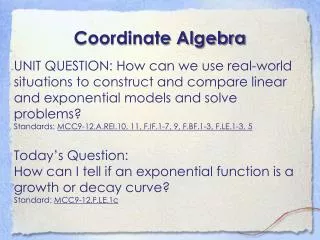
Coordinate Algebra • UNIT QUESTION: How can we use real-world situations to construct and compare linear and exponential models and solve problems? • Standards: MCC9-12.A.REI.10, 11, F.IF.1-7, 9, F.BF.1-3, F.LE.1-3, 5 • Today’s Question: • How can I tell if an exponential function is a growth or decay curve? • Standard: MCC9-12.F.LE.1c
Example 1 y = 2x Domain: Range: Asymptote: Increase/Decrease
Example 2 f(x) = 2x – 1 Domain: Range: Asymptote: Increase/Decrease
Example 3 f(x) = 2x – 1 + 3 Domain: Range: Asymptote: Increase/Decrease
What transformations would be applied to the following functions? Right 4 Right 3, down 7 Reflect across the x, left 2, up 5
Growth or Decay b > 1 0 < b < 1
Growth, Decay, Refl. Growth or Refl. Decay? growth decay growth decay reflected growth growth