

SlideServe
Menu
Préférences
© SlideServe · v2026

Carboxylic Acids

jayme avatar
21 diapositives · 1.1K Views · Sep 04, 2012

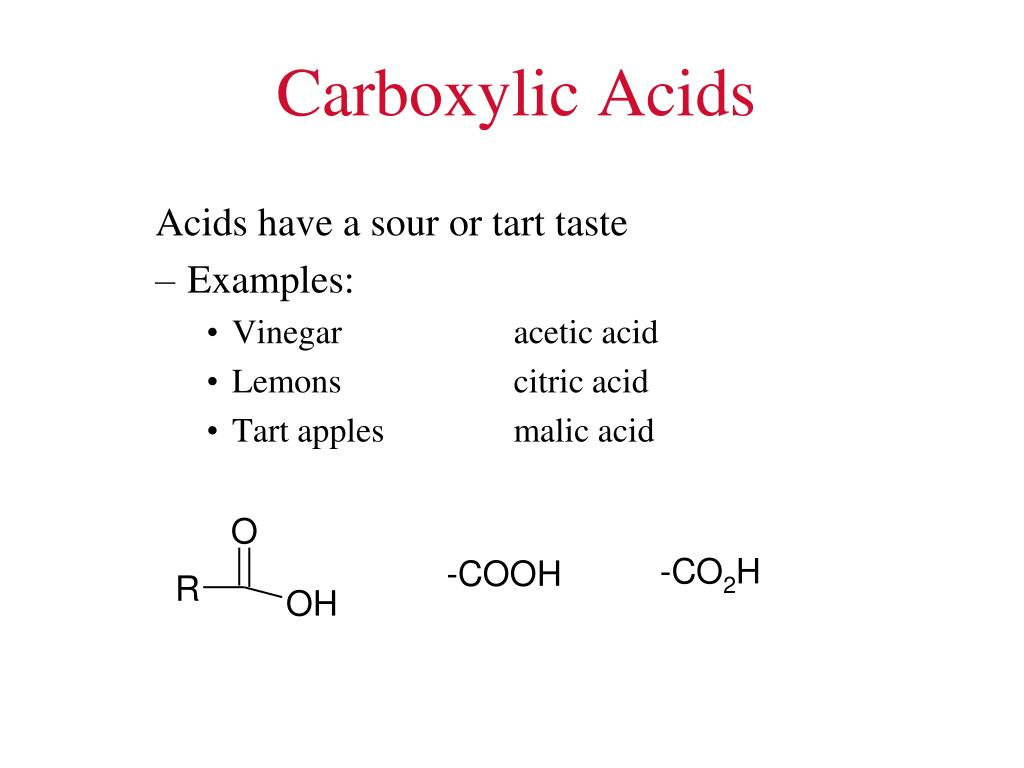
Carboxylic Acids. Acids have a sour or tart taste Examples: Vinegar acetic acid Lemons citric acid Tart apples malic acid. Nomenclature. Drop the e and ad oic acid If two acid groups in a molecule – keep the e and say dioic acid Carb onyl C is always is number 1 carbon
Carboxylic Acids - slide 1
01 / 21Carboxylic Acids
1 / 17

Télécharger la présentation

Carboxylic Acids
Une image / un lien ci-dessous est fourni (tel quel) pour télécharger la présentation

Politique de téléchargement : le contenu du site vous est fourni TEL QUEL pour votre information et votre usage personnel ; il ne peut être vendu, concédé sous licence ni partagé sur d’autres sites sans l’accord de son auteur.Le contenu vous est fourni TEL QUEL, pour votre information et votre usage personnel uniquement. Téléchargez la présentation en cliquant sur ce lien. Lors du téléchargement, si vous ne parvenez pas à télécharger une présentation, l’éditeur a peut-être supprimé le fichier de son serveur.Pendant le téléchargement, si vous ne parvenez pas à obtenir une présentation, le fichier a peut-être été supprimé par l’éditeur.

F I N

Plus de contenu associé

Transcription de la présentation
  1. Carboxylic Acids Acids have a sour or tart taste • Examples: • Vinegar acetic acid • Lemons citric acid • Tart apples malic acid

  2. Nomenclature • Drop the e and ad oic acid • If two acid groups in a molecule – keep the e and say dioic acid • Carbonyl C is always is number 1 carbon • Also called an “acyl” group Practice some on the board

  3. Nomenclature # C Common Name IUPAC Name 1 Formic acid Methanoic acid 2 Acetic acid Ethanoic acid 3 Propionic acid Propanoic acid 4 Butyric acid Butanoic acid 5 Valeric acid Pentanoic acid 6 Caproic acid Hexanoic acid http://www.youtube.com/watch?v=AntCzWw-28s

  4. Remembering Nomenclature • Formic acid… “ant acid” • Acetic acid……. “acetum” (Latin=vinegar) • Butyric acid…….. “butter acid” • Caproic acid………. “goat acid” • Unbranched 3-10……. “fatty acids”

  5. Carboxylic acids Alcohols Increasing BP Ethers/Aldehydes/Ketones Alkyl halides Alkanes Physical Properties • Highest bp of compounds studied so far! B

  6. Physical Properties • Higher boil points due to hydrogen bonding and • Carboxylic acid dimers • Two identical units 2 1o alcohol B

  7. Physical Properties • Foul odors • butyric acid stale perspiration locker room odor, rancid butter • valeric acid smells worse (goat smell) From Yahoo Images B

  8. Solubility of Organics • One electronegative group per four carbons will make a compound dissolve in water

  9. Fatty Acids • Long un-branched carboxylic acids • Most have between 12 and 20 carbons • Derived from the hydrolysis of fats • Most have an even number of C’s • If unsaturated, the cis isomer predominates • Unsaturated have lower melt points than saturated

  10. Melting Points Saturated have higher melting points than unsaturated fatty acids

  11. Soap • Soap is made by adding NaOH to a fat • This reaction is called soponification • This cleaves each of the fatty acids producing the solid fatty acid salt (soap) • The other product is glycerol

  12. Soap

  13. Soap Micelles

  14. Modern Detergents Dodecylbenzene Sodium 4dodecylbenzenesulfonate

  15. Acidity due to Electron Withdrawing Groups

  16. Carboxylic Acid Reactions React as an acid with a base

  17. Separation using soluble salts

  18. Reduction To an Alcohol Reduction is difficult for acids, but Lithium Aluminum Hydride will do it

  19. Fischer Esterification

  20. Decarboxylation