
The Scientific Method
E N D
Presentation Transcript
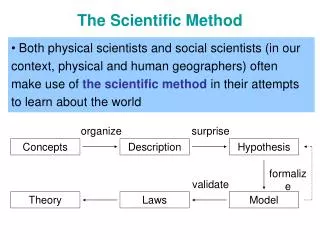
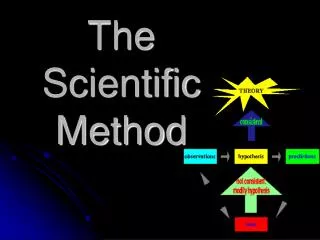
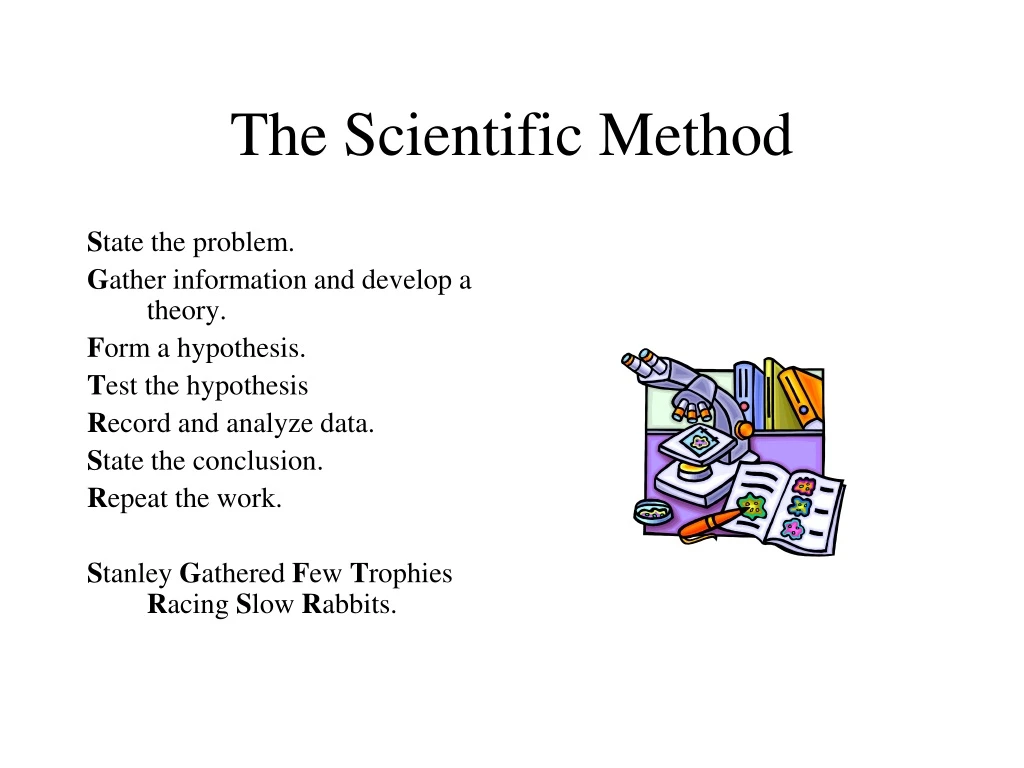
The Scientific Method State the problem. Gather information and develop a theory. Form a hypothesis. Test the hypothesis Record and analyze data. State the conclusion. Repeat the work. Stanley Gathered Few Trophies Racing Slow Rabbits.
Scientific Theories... • Explain through an integrated set of principles that organizes and predicts behaviors and events. • Seek to simplify things by organizing isolated facts • Must imply testable predictions (hypotheses) that enable a researcher to test/revise theory and derive practical applications from it
What does every good experiment need? • Hypothesis – measurable prediction • Replication – ability to repeat study/experiment • Population – all the cases in a group • Control condition – contrasts with experimental condition – that which is not manipulated (more about this later) • Random assignment – assigning subjects to experimental condition by chance
What does every experiment… • Independent variable – that which is being manipulated – the variable whose effect is being studied • Dependent variable – what is being measured. May change in response to manipulations of independent variable • Operational definition – statement of procedures used to define variables
What does every experiment… • Random sample – represents a population. Each member has an equal chance of inclusion in study. • Experimental condition – the condition that exposes subjects to one treatment
More About Eliminating Bias and Confounding Variables • Need to eliminate: • experimenter bias: researcher expectations influence results and bias the results • demand characteristics: subjects discover the purpose of study and this “suggests” how they should respond
Eliminating Demand Characteristics • Use single-blind procedure • Research design where participants don’t know which treatment group they are in (experimental vs. control) • Sometimes involves a placebo • Placebo: control condition; imitation pill, injection, patch, treatment etc. • Placebo effect: now used to describe any cases when experimental participants change their behavior in the absence of any kind of experimental manipulation.
Eliminating Experimenter Bias and Demand Characteristics • Use the double-blind study • Both the experimenter and the subjects don’t know which group each subject is in (experimental group or control group)
More About Controls • Between-subjects design • Participants in experimental and control groups are different individuals • Within-subjects design • Each participant is his or her own control • Ex: behavior of an experimental participant before receiving a treatment might be compared to his or her behavior after receiving a treatment • Counterbalancing • Used to eliminate order effects • Ex: half of subjects might have one of the treatments first and the other half of subjects might have the other treatment first