How to Succeed at Interviewing Without Really Crying
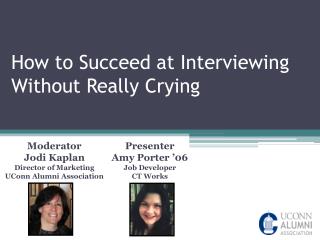
How to Succeed at Interviewing Without Really Crying. Moderator Jodi Kaplan Director of Marketing UConn Alumni Association. Presenter Amy Porter ’ 06 Job Developer CT Works. So you ’ re looking for a new job because you ’ re…. …unemployed …unhappy with your current job and/or salary

How to Succeed at Interviewing Without Really Crying
E N D
Presentation Transcript
How to Succeed at Interviewing Without Really Crying Moderator Jodi Kaplan Director of Marketing UConn Alumni Association Presenter Amy Porter ’06 Job Developer CT Works
So you’re looking for a new job because you’re… …unemployed …unhappy with your current job and/or salary …looking for a career change …brushing up on your interviewing skills
Let’s start with YOU • Who are you? • What are your skills? • What do you like to do?
What about the JOB? • What do you want to do? • Where do you look? • What do you look for? • Deciphering the job posting • Resume
O*NET OnLine • Career exploration • Job analysis • Resume writing • ONETONLINE.ORG
Know the different types of interviews: • Informational • Screening or Telephone • Individual • Group • Panel • Sequential • Behavioral • Task-oriented or Testing • Stress • Breakfast, Lunch, or Dinner • Video or Videoconferencing • Second
Research • The company (including competition) • CEOs, recruiters, interviewer(s) • The industry
Rehearse Answers to Common Questions • Tell me about yourself. • Why do you want to join our company? • What are your greatest strengths/weaknesses? • Where do you see yourself in five years? • What is your greatest accomplishment? • Why are you looking to leave your current employer?
Prepare Questions to Ask Interviewer • Why ask questions? • How many? • What is appropriate?
Examples • What characteristics are you seeking in the ideal candidate? • Can you describe a typical day or week? What are some of the projects I will be working on? • How and when will my performance be evaluated on this job? • What training and professional development opportunities are available for this position? • What are your expectations for a new hire within the next six to twelve months? • What are the organization's plans for future growth or change? • How would you describe your management style? • Is there anything you are still wondering about my candidacy that might keep you from offering me the position? • What is the next step in the process?
The Night Before • Press and lay out interview clothes • Polish shoes and jewelry as needed • Assemble portfolio/briefcase • Review resume, elevator speech, and answers • Go to bed early
The Day of the Interview • Wake up early • Eat breakfast • Grooming • Clothing • Accessories • Perfume/Cologne
Before you leave the house… • Professional portfolio or briefcase, black or blue pens, notepad • Three copies of your resume, typed references, and work samples • List of questions for interviewer(s) • List of previous employers, phone numbers, addresses, salaries, dates, etc. • Time management (arrive no later than 15 minutes prior to interview) • Address, directions and contact information for employer • Names and titles of your interviewers • Cell phone, photo ID, and an umbrella • Personal grooming items: breath mints, hairbrush, deodorant, safety pins, makeup, extra pair of nylons
Waiting in Reception? • Turn off cell phone • Be polite to receptionist/security guard • Review your notes • Read company literature • Stay calm and focused
First Impressions • Greet the interviewer • Smile • Introduce yourself • Shake hands firmly and warmly • Stand until the interviewer asks you to sit down • Relax and sit naturally • Use direct eye-contact • Be prepared to make small-talk
How to Handle Difficult Questions • What are your weaknesses and/or failures at work? • Explain work gaps/reasons for leaving/frequency of jobs? • You have a lot of experience. Why would you want this lower level job? • How do you handle stress? • What are you doing now to improve yourself? • Describe the worst supervisor/coworker you’ve ever had to work for/with. • Explain the rationale of each career move after college. • Describe a job that would be your worst nightmare. • I have several good people to choose from. Why should I hire you? • What are your salary requirements?
Interviewing Don’ts • Lacking humor, warmth or personality • Appearing uninterested or desperate • Failure to set yourself apart from other candidates • Failing to demonstrate skills • Making demands or refusing to do/learn something new • Speak negatively about current or previous employers • Giving lengthy answers/over-explaining why you lost a job • Asking about salary, benefits, bonus structure • Believing the interviewer is an expert • Answering cell phone or text • Chewing gum • Poor body language: no eye-contact, bad posture, crossing arms/legs, fidgeting, excessive hand gestures • Fashionable/trendy clothing • Tardiness
Closing the Interview • Collect business cards of each interviewer • Thank them for their time • Reaffirm interest
Follow Up • Thank you note • Provide additional documents/information • Keep detailed records • Maintain contact
Alumni Career ResourcesSponsored by the UConn Alumni Association Missed a Career Webinar?Need more Career ResourcesWant to connect with fellow Huskies?Check out the New Alumni Career Resources website at:http://uconnalumni.com/career-resources.html