Understanding the Muscular System: Types, Functions, and Mechanisms of Movement
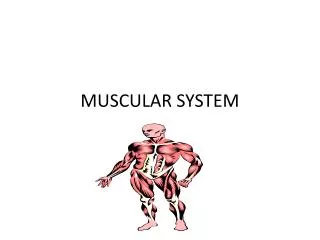
The muscular system is crucial for generating force, enabling movement, and facilitating physical expression. It consists of three types of muscle tissue: skeletal, smooth, and cardiac. Skeletal muscles are voluntary and responsible for body movement, while smooth muscles are involuntary and found in internal organs. Cardiac muscle, unique to the heart, is autorythmic and maintains a steady beat. Muscle contraction occurs through the sliding filament mechanism involving myofibrils and sarcomeres. Understanding muscle types and their functions is essential for addressing muscle degeneration and promoting rehabilitation.

Understanding the Muscular System: Types, Functions, and Mechanisms of Movement
E N D
Presentation Transcript
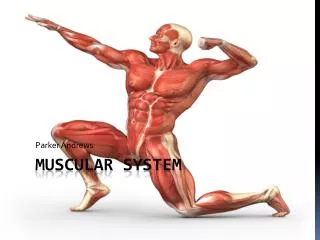
Parker Andrews Muscular System
function • Generate force • Movement • In some ways communicate (physical expressions) • The ability to use chemical energy to produce force and energy is present in all cells but is a dominate characteristic of muscle cells.
3 Types of muscle tissue • Skeletal • Smooth • Cardiac • Single muscle cell is referred to as a muscle fiber • Skeletal and cardiac are group together in the sense that they are both striated. And are both cylindrical
striation • Cardiac and skeletal muscle are called striated because there is thick and thin filaments called myofibrils • The thin part is composed of Actin Troponin and Tropomysoin • Thick part is composed of myosin • the gap between the striations is called a cross bridge • This thick and thin pattern repeats it’s self. One section of this pattern is called a sarcomere
How movement occurs • Contraction (movement) happens through a process called sliding-filament mechanism • The cross bridge attaches to the thin filament and pulls it toward the center of the sarcomere resulting in a contraction
Skeletal muscles • Are Voluntary • are used to move the body as well as keep it in place. • Can be replaced by satellite cells that are located adjacent to major muscles. Satellite cells are basic and undifferentiated that can specialize to replace skeletal muscle but will not function to full strength • Tendons- muscle to bone • Ligaments- bone to bone • * the nucleus is located on the outside edge of cell. Why is this?
Smooth muscle • INVOLUNTARY • Found in muscles that are involuntarily controlled by the brain. • Broke into two groups… single unit and multiunit • Single unit-whole muscle responds as a group • Multiunit- each cell responds independently dependant upon nerve frequency
Cardiac muscle • Muscles of the heart • Branched rather than cylindrical • Is Autorythimatic- holds steady beat involuntarily • Generates own action potential • *what is the gap that the branch crosses between the branches of heart muscle called?
PROBLEM • Muscle degeneration is the most common • Result of lack of use or major injury • Two main treatments are physical therapy or a work out program.
Citations • "Interactive Biology, by Leslie Samuel." Interactive Biology by Leslie Samuel. N.p., n.d. Web. 28 Aug. 2013. • Widmaier, E.P.W., Raft, H.R., and Strang, K.T.S. (2008). Wander’s Human Physiology:TheMechianism of body functions. (11ed, pp. 254-279). New York, NY: McGraw-Hill Higher Education • “Rich Wilkie's Portfolio: Character Design." Rich Wilkie's Portfolio: Character Design. N.p., n.d. Web. 28 Aug. 2013. • "Mammalian Smooth Muscle Tissue." Olympus Microscopy Resource Center. N.p., n.d. Web. 28 Aug. 2013. • “Muscle." Muscle. N.p., n.d. Web. 28 Aug. 2013. • “Molecular Expressions Microscopy Primer: Anatomy of the Microscope - Brightfield Microscopy Digital Image Gallery - Mammalian Smooth Muscle Tissue." Molecular Expressions Microscopy Primer: Anatomy of the Microscope - Brightfield Microscopy Digital Image Gallery - Mammalian Smooth Muscle Tissue. N.p., n.d. Web. 28 Aug. 2013. • "Illustration of Man Working Out." Illustration Of Man Working Out. Royalty Free Illustration by FeaturePics.com. N.p., n.d. Web. 28 Aug. 2013. • "Bicep Development for Beginners." Bicep Development for Beginners. N.p., n.d. Web. 28 Aug. 2013. • "Anatomy Atlases: Atlas of Microscopic Anatomy: Section 1 - Cells." Anatomy Atlases: Atlas of Microscopic Anatomy: Section 1 - Cells. N.p., n.d. Web. 28 Aug. 2013.
Happy HappyHappy • Study silently for the next 5 minutes for your quiz.