Download

1 / 10
120 likes | 241 Vues
This introduction to angles covers the fundamental concepts of lines, rays, and angles. A line extends infinitely in both directions, while a ray has one endpoint and extends indefinitely in one direction. Angles are formed by two rays sharing a common endpoint, known as the vertex. This guide explains naming angles and the classification of angles into complementary and supplementary types. Complementary angles sum to 90 degrees, while supplementary angles total 180 degrees. Examples and activities are included for practice.

E N D
Introduction to Angles Complementary and Supplementary
Lines, Rays, and Angles A line goes forever in both directions. It is perfectly straight, and never ends. A ray goes forever in one direction. It has one endpoint. An angle is two rays that share an endpoint.
Parts of an Angle • The point where the rays intersect is called the vertex of the angle. • The two rays are called the sides of the angle.
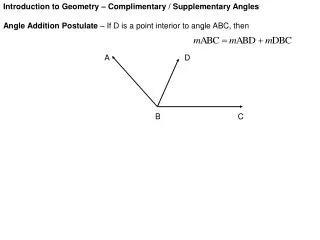
Naming Angles ABC A • Use the vertex and a point from each ray to name the angle. The vertex must be the middle letter. CBA B C Sometimes we put this symbol in front of an angle:
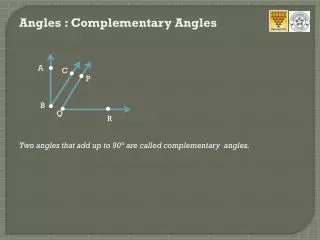
Complementary Angles • Two angles are called complementary angles if the sum (add) of their degree measurements equals 90 degrees. • Complementary Angles make a Right Angle.
Example: Complementary Angles
Supplementary Angles • Two angles are called supplementary angles if the sum of their degree measurements equals 180 degrees. • Supplemental Angles make a Straight Line.
Example: Supplementary Angles
Find the complementary and supplementary angles for each.Use half sheet of paper. • 73 2) 40 3) 29 • 87 5) 56 6) 13