Download
1 / 43
430 likes | 531 Vues
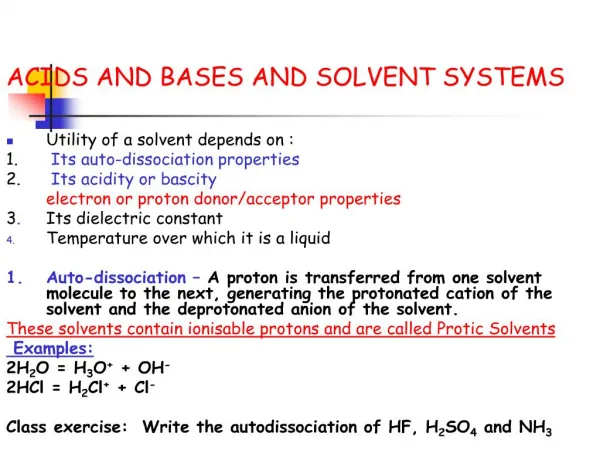
This comprehensive overview of acids and bases explores their defining characteristics, including taste, ion donation, pH, and electrical conductivity. Acids are identified by their sour taste and ability to form hydronium ions, while bases are noted for their bitter taste and slippery feel. The text examines the pH scale, illustrating how concentrations of hydronium and hydroxide ions relate to the strength of acids and bases. Additionally, it covers neutralization reactions and common household substances, emphasizing how they work and their chemical properties.

E N D
Goal 1Compare and contrast the characteristics of acids and bases
Acids 1. Taste sour
2. Donates Hydrogen ions H+ 3. Forms Hydronium ions H3O+ Products of a chemical reaction will showH3O
Products of a chemical reaction will showH3O HCl + H2O H3O+ + Cl-
4. Turns Universal Indicator to RED
Stomach acid Battery acid Examples
Bases 1. Tastes Bitter
2. Hydroxide ions OH- KOH K+ + OH- NH3 + H2O NH4+ + OH-
3. Turns Universal Indicator to BLUE
Examples Sodium hydroxide pellets
Goal 2Relate the pH value to the concentration and strength of a dissolved acid or base
Concentration changes by powers of 10 pH =1 has 10x more than pH = 2 pH = 1 has 100x more than pH = 3 More Less 1 2 3 4 5 6 7 8 9 10 11 12 13 14
Acid + Base water H3O+ + OH- H2O
KOH + HNO3 H2O + K+ + NO3- Is it balanced?
Must have = amounts of hydronium and hydroxide ions to completely neutralize
Goal 4Explain how common acidic and basic household substances work
Soap = basic surrounds oily substances allows emulsion in water Whisked away!
Molarity • Molarity = moles solute Liters of solution Tells us how strong a solution is... the higher the molarity, the more solute is dissovled in the liquid. A 10M acid is much stronger than a 1 M acid.
Remember moles??? • Use the periodic table to find how many grams there are in one mole of a substance • CuSO4 • Cu = 64 g/mole • S = 32 g/mole • O = 16 g/mole X 4 • 159 g/mole
% by volume • Another way to talk about solution strength is to refer to the percent by volume. • Only used when a liquids is dissolved in a liquid • % v/v = Volume of solute X100 Volume of solution
% by mass • When units are all in grams…. • % m/m = grams solute X 100 grams solutions
Detergents = basic lather in hard water do not form soap scum
Ammonia = basic emulsifies oil whisked away!
Bleach = basic Disinfectant kill bacteria & viruses
Thanks to the following people who have generously shared their images on the creative commons of Flickr: Progoddess…I love lemon & peppermint Frotzed2… gave your kid a lemon Bunchofpants… pickle on a fork Brad Lauster… Big Papa G.J. Charlet III… hey kool-aid! Interplast… acid burn Duchamp… electric pickle Deanj… Old ray-o-vacs Wallyg… Homer!! Jemsweb… walnut Greg McElhatton… unsweetened chocolate Santoslilhelper… slippery when wet
Thanks to the following people who have generously shared their images on the creative commons of Wikipedia: Walkerma… sodium hydroxide pellets
Want to see something cool? Copy this link to your browser http://pickle.xr.ca/
Acid + Base water + salt H3O+ + Cl- + Na+ + OH- 2H2O + Na+ + Cl-