Understanding Reproductive Strategies: Evolution of Life on Land
200 likes | 356 Vues
This article explores the diverse reproductive strategies employed by various organisms, focusing on sexual and asexual reproduction. It discusses internal and external fertilization mechanisms, adaptations for terrestrial life, and the unique reproductive processes of mammals, birds, reptiles, insects, and flowering plants. The advantages and disadvantages of both sexual and asexual reproduction are examined, along with the significance of parental care in different species. This comprehensive overview highlights the intricate relationships between life forms and their environments.


Understanding Reproductive Strategies: Evolution of Life on Land
E N D
Presentation Transcript
Key Themes • 2 Types of reproduction (sexual & asexual) • Both internal and external fertilisation • Adaptations to life on land • Eggs (birds and reptiles) • Internal gestation (mammals) • Insects • Flowering plants
Asexual reproduction • Individuals are genetically identical (clones) • Cells with diploid number are produced by mitosis • Advantages: • Disadvantages:
Sexual reproduction • Produces offspring that are genetically different • Haploid cells or gametes are produced by meiosis • Advantages: • Disadvantages:
Males and females produce different sized gametes • Fertilisation involves the fusion of a haploid sperm and a haploid egg diploid zygote
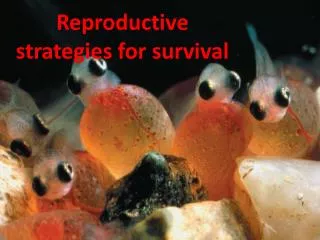
Most aquatic beasties undergo External Fertilisation • will lay eggs (sometimes in a nest) • then spread sperm over those eggs
Internal fertilisation • Advantages:
In many animals the fertilised egg / zygote actually develops outside of the body • Examples? • When this is the case, a large number are produced to increase survival
Adaptations to life on land • Amphibians • Reptiles • Birds • Mammals All these _____ show increasing adaptations for colonising the land
Reptiles and Birds • Evolution of the amniotic egg • Anatomy of the egg: • Fluid filled cavity • Membrane • Protective shell • Encloses embryo inside the yolk sac • Birds incubate eggs, the embryo completing development outside the mothers body
Mammals • Young are retained in uterus / womb without a shell • Embryo is nourished there from mother’s blood supply via a placenta • Means that young can be born fairly well advanced in terms of development discussion point: Different species have diff strategies on this
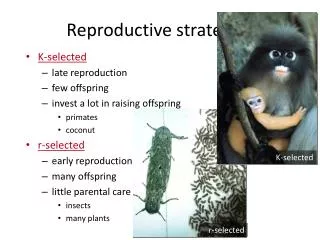
Parental care • What animals exhibit parental care? • What are the advantages? • How many offspring do your examples have? • Name something that has no parental care… • How many offspring does that have? *As degree of parental care increases, number*of offspring decreases
Insects • Abundant, Diverse & Widespread Insects lives and lifestyles affect almost all other terrestrial organisms • Insect zygotes develop into an intermediate form (nymph or larva) before becoming an adult
Nymphs Nymphs resemble the adults They go through several moults (instar) Incomplete metamorphosis
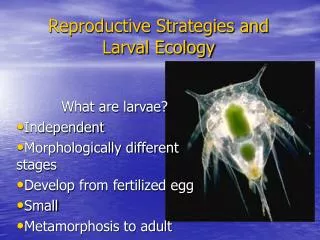
Larvae Different from the adult form Larval stage followed by pupa Then complete metamorphosis into the adult
Flowering Pants • Flowering Plants are well adapted for life on land in terms of their morphology and reproduction
They have similar reproductive strategies to animals for colonisation. … what are they? http://www.videopediaworld.com/video/22961/11-30-the-private-life-of-plants--03--flowering
Plant relationships • Key to plant success is their relationship with animals: • Pollination • Seed Dispersal
The Seed • Food store enables embryo to develop until leaves are produced • Resilient coat allows it to withstand adverse conditions