Understanding Boolean Algebra: Key Concepts and Theorems in Chapter 3
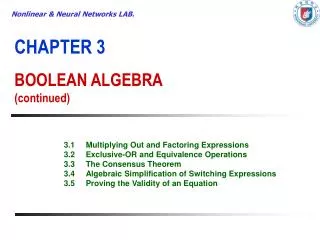
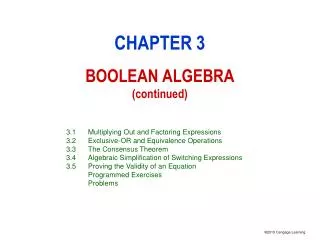
This chapter delves into essential concepts of Boolean Algebra, encompassing objectives such as multiplying and factoring expressions, operations of Exclusive-OR and equivalence, and the application of the Consensus Theorem. It includes algebraic simplification of switching expressions and methods for proving the validity of equations. Additionally, programmed exercises help reinforce learning. Key examples and figures are provided throughout for better comprehension, making this chapter a critical component for anyone seeking to master Boolean Algebra.

Understanding Boolean Algebra: Key Concepts and Theorems in Chapter 3
E N D
Presentation Transcript
This chapter in the book includes: Objectives Study Guide 3.1 Multiplying Out and Factoring Expressions 3.2 Exclusive-OR and Equivalence Operations 3.3 The Consensus Theorem 3.4 Algebraic Simplification of Switching Expressions 3.5 Proving the Validity of an Equation Programmed Exercises Problems FIGURES FORCHAPTER 3BOOLEAN ALGEBRA(continued) Click the mouse to move to the next page. Use the ESC key to exit this chapter.
Example (3-20), p 63 The consensus theorem can be stated as follows: XY + X'Z + YZ = XY + X'Z Proof: XY + X'Z + YZ = XY + X'Z + (X + X')YZ = (XY + XYZ) + (X'Z + X'YZ) = XY(1 + Z) + X'Z(1 + Y) = XY + X'Z
Example 1, p 66 A'BD' + BCD + ABC' + AB'D = BC'D' + AD + A'BC