Download
1 / 16
160 likes | 282 Vues
Discover the transformative power of Web 2.0 tools for online collaboration and community engagement. This overview highlights platforms like VoiceThread, which facilitates multimedia conversations and builds community while reducing transactional distance. Additionally, LibraryThing encourages reading and community development through tagging and discussions. Explore how these tools enable seamless interaction amongst users, fostering a sense of interconnectedness and shared learning experiences.

E N D
Web 2.0Cool Tools for Online Collaboration • Wade Bradt & Samantha Tackett
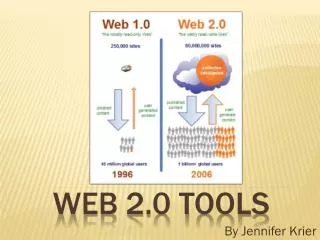
ParadigmShift • Web 1.0 • access to information badidea.co.uk
ParadigmShift • Web 1.0 • access to information • Web 2.0 • facilitate interactivity merkenmarketeers.be Producer Distributor Consumer
“Produsage” midorimiller.com
VoiceThread • Facilitates conversations • Integrates media • Builds community • Reduces Transactional Distance voicethread.com
VoiceThread Holding “conversations” around: • documents • images • video voicethread.com
VoiceThread • WorkflowSolutions • Social Networking • AcademicCollaboration voicethread.com
LibraryThing • Builds Community • Encourages Reading • Provides meta-data librarything.com
LibraryThing • Groups • Talks • Reviews • Tagging newknowledgepress.com
LibraryThing • Author & Tag Clouds • Personalized Profile • Invite Friends 24hourreadathon.com
Discussion • Community development • Transactional distance playford.sa.gov.au
References Boyd, D. M. and Ellison, N. B., (2007). Social network sites: Definition, history and scholarship. Journal of Computer-Mediated Communication, 13(1), article 11. http://jcmc.indiana.edu/vol13/issue1/boyd.ellison.html Bransford, J.D., Brown, A.L., & Cocking, R., (2000). How people learn: Brain, mind, experience, and school. Washington, DC: National Academy Press. Bruns, Axel, (2007). Produsage: Towards a broader framework for user-led content creation. New York: Peter Lang. Cavanaugh, Terence W. and Cathy Cavanaugh, (2008). Interactive Maps for Community in Online Learning. Computers in the Schools, 1528-7033, Volume 25, Issue 3, 2008, Pages 235 – 242. New York: Routledge. Driscoll, M.P., (2000). Psychology of learning for instruction (2nd ed.). Boston, MA: Allyn and Bacon. Shirky, Clay, (2008). Here comes everybody. New York, NY: Penguin Group.
More CoolTools • www.go2web20.net/