Enrollment Analysis of Math Majors in Spring Courses Using Venn Diagrams
A survey of 100 undergraduate math majors reveals their enrollment in real analysis, differential equations, and linear algebra during the spring semester. The data shows the number of students enrolled in each course, as well as the overlaps between them, particularly those enrolled in multiple courses. By employing the Principle of Inclusion-Exclusion with a Venn diagram, we can derive the number of students enrolled in all three courses. This analysis is crucial for understanding course demand and student engagement in mathematics.


Enrollment Analysis of Math Majors in Spring Courses Using Venn Diagrams
E N D
Presentation Transcript
Problem presentation Meng Li
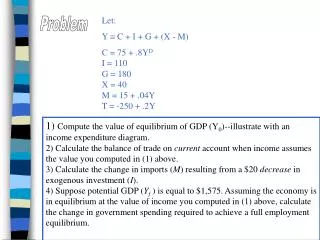
Problem Set 3 • #22:In a survey of 100 undergraduate math majors at a certain university, the following information is obtained about the courses they are taking during the spring semester: • 41 are enrolled in real analysis • 44 are enrolled in differential equations • 48 are enrolled in linear algebra • 11 are enrolled in both real analysis and linear algebra • 14 are enrolled in both real analysis and differential equations • 19 are enrolled in both differential equations and linear algebra • 10 are not enrolled in any of these three courses • How many students are enrolled in all three of these courses?
There are lots of information, what can we do? Venn diagram must be the best choice!
Solution: See Blackboard ^-^
Easy way to solve the problem: • The Principle of Inclusion-Exclusion: • If A1, A2, …, An are n≥2 finite sets, then: • |A1∪A2∪…∪An|=∑1≤i≤n|Ai|-∑1≤i<j≤n|Ai∩Aj|+∑1≤i<j<k≤n|Ai∩Aj∩Ak|-… +(-1)n+1|A1∩A2∩…∩An|