Understanding Platoon Dispersion in the TRANSYT-7F Traffic Flow Model
130 likes | 266 Vues
TRANSYT-7F, a U.S. adaptation of the UK TRANSYT model, incorporates both optimization and macroscopic simulation components to analyze traffic flow. A key aspect of this model is the Platoon Dispersion, which accounts for the dispersion of vehicle platoons originating from traffic signals over time and space. This dispersion leads to non-uniform vehicle arrivals at downstream signals, affecting vehicle delay calculations and overall signal effectiveness. By understanding this model, traffic engineers can improve timing and progression strategies at signalized intersections.


Understanding Platoon Dispersion in the TRANSYT-7F Traffic Flow Model
E N D
Presentation Transcript
Topic 5 Platoon and Dispersion
TRANSYT-7F MODEL • TRANSYT is a computer traffic flow and signal timing model, originally developed in UK. • TRANSYT-7F is a U.S. version of the TRANSYT model, developed at U of Florida (Ken Courage) • TRANSYT-7F has an optimization component and a simulation component. • The simulation component is considered as a macroscopic traffic simulation, where vehicles are analyzed as groups. • One of the well known elements about TRANSYT-7F’s traffic flow model is the Platoon Dispersion model.
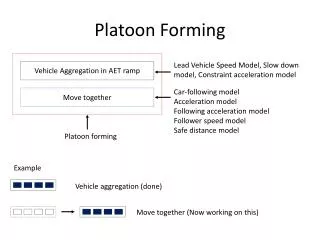
WHY MODEL PLATOON DISPERSION? • Platoons originated at traffic signals disperse over time and space. • Platoon dispersion creates non-uniform vehicle arrivals at the downstream signal. • Non-uniform vehicle arrivals affect the calculation of vehicle delays at signalized intersections. • Effectiveness of signal timing and progression diminishes when platoons are fully dispersed (e.g., due to long signal spacing).
PLATOON DISPERSION MODEL • For each time interval (step), t, the arrival flow at the downstream stopline (ignoring the presence of a queue) is found by solving the recursive equation
PLATOON DISPERSION Flow rate at interval t, qt 100 % Saturation 50 0 Time, sec Start Green T = 0.8 * T’ Flow rate at interval t + T, Q(T+t) 100 % Saturation 50 0 Time, sec
CLOSED-FORM PLATOON DISPERSION MODEL s Flow rate, vph v 0 tq tg Time C
CLOSED-FORM PLATOON DISPERSION MODEL (1~tq) For 1~tq with s flow
CLOSED-FORM PLATOON DISPERSION MODEL (0~tq) (1) (2) (1) – (2)
CLOSED-FORM PLATOON DISPERSION MODEL (1~tq) For 1~tq with s flow Maximum flow downstream occurs at T+tq with upstream s flow
BEYOND (1~tq) From the original equation: s no longer exists, but zero flow upstream t = tq +1 ~ ∞ • This is mainly to disperse the remaining flow, Qs,max. Upstream flow is zero • The same procedure for the non-platoon flow • The final will be the sum of the two
EXAMPLE • Vehicles discharge from an upstream signalized intersection at the following flow profile. Predict the traffic flow profile at 880 ft downstream, assuming free-flow speed of 30 mph, α = 0.35; β = 0.8. Use time step = 1 sec/step 3600 Flow rate, vph 1200 0 16 28 Time C=60 sec