Understanding Evolution: Microevolution, Macroevolution, and the Geologic Time Scale
This overview of evolution explores the concepts of microevolution and macroevolution, detailing changes in allele frequencies in populations over time and large-scale events leading to species extinction and formation. It introduces the geologic time scale, including eons, eras, periods, and epochs, and discusses methods for dating these geological units, such as radiometric and luminescence dating. Significant extinction events and the Cambrian Explosion are also highlighted, providing a comprehensive understanding of life's evolutionary history on Earth.

Understanding Evolution: Microevolution, Macroevolution, and the Geologic Time Scale
E N D
Presentation Transcript
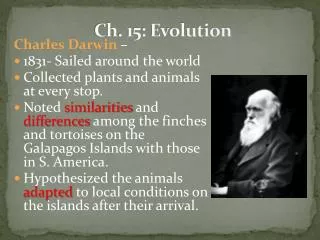
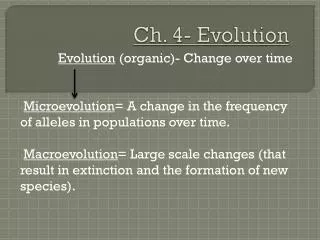
Ch. 4- Evolution Evolution (organic)- Change over time Microevolution= A change in the frequency of alleles in populations over time. Macroevolution= Large scale changes (that result in extinction and the formation of new species).
Macroevolution has given us a geologic time scale = “calendar” of Earth history. Structure of the geologic time scale: Eon – the greatest expanse of time Era– subdivision of an eon Eras are subdivided into periods Periods are subdivided into epochs
How do we place numeric ages (years) on geologic units? – Radiometric Dating= Uses radioactive isotopes of atoms (Ex. Carbon-14: half-life=5730 years) – Cosmogenic Dating – Luminescence Dating
Geologic Timescale Significant Events http://www.dimaggio.org/Evolution/5major.htm EXTINCTIONS: 1. Cretaceous-Tertiary extinction: about 65 MYA 2. End Triassic extinction: about 199 - 214 MYA 3. Permian-Triassic extinction: about 251 MYA *Earth’s worst mass extinction 4. Late Devonian extinction: about 364 MYA 5. Ordovician-Silurian extinction: about 439 MYA
Cambrian Explosion- Beginning some 545 million years ago, an “explosion” of diversity led to the appearance of a huge number of complex, multi-celled organisms over a relatively short period of time.