Understanding Dew, Humidity, and Evaporation: Key Concepts in Atmospheric Science
This lesson explores the concept of relative humidity and its relation to dew formation. Students will learn about the term that refers to the opposite of evaporation, understand why dew forms on some days while grass remains dry on others, and delve into the differences between relative humidity and absolute humidity. Key terms such as saturation and the measurement of humidity as a percentage are discussed. Additionally, the process to determine relative humidity is explained in detail to ensure a comprehensive understanding for all students.

Understanding Dew, Humidity, and Evaporation: Key Concepts in Atmospheric Science
E N D
Presentation Transcript
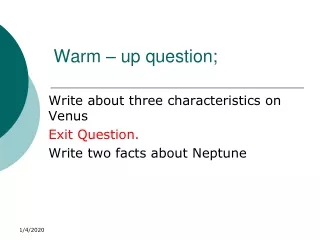
Warm Up Question What is the name of the term that refers to the opposite of evaporation? Why do some days have dew on the grass, and other days the grass is dry? Let’s assume the sprinklers are not a factor.
Absolute Humidity- The amount of water in grams that can be dissolved in the air at a particular temperature. Expressed in grams of water per kilogram of air. Saturation- When the air cannot dissolve any more water vapor. The air is said to be saturated, or at 100% humidity. Relative Humidity. Expressed as a percentage of the amount of water vapor that can be dissolved into the air at a particular temperature.
Closure: Describe the process of how relative humidity is determined in enough detail that an absent student could understand how to do it.