Mastering Chemical Reactions: Steps and Tips for Balancing Equations
40 likes | 166 Vues
This guide provides essential steps and helpful tips for balancing chemical equations effectively. It outlines a systematic approach starting from writing the unbalanced equation to ensuring atom balance. Key steps include counting atoms, adding coefficients, and reducing to the lowest possible ratio. The importance of balancing one element at a time, updating atom counts after adding coefficients, and handling polyatomic ions as single units are emphasized. Additionally, a balancing example involving aluminum and copper(II) chloride illustrates the process clearly.


Mastering Chemical Reactions: Steps and Tips for Balancing Equations
E N D
Presentation Transcript
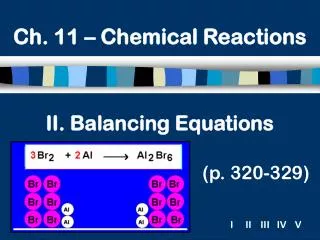
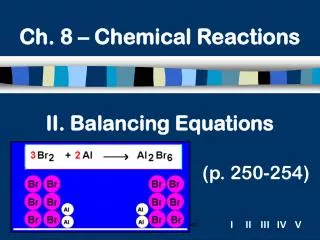
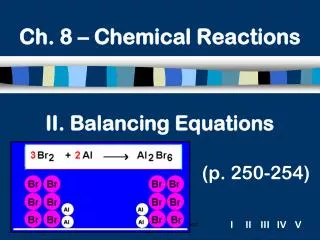
Ch. 8 – Chemical Reactions II. Balancing Equations(p. 250-254) C. Johannesson
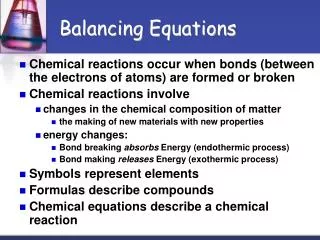
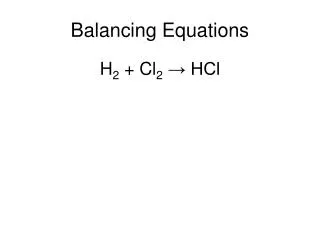
A. Balancing Steps 1. Write the unbalanced equation. 2. Count atoms on each side. 3. Add coefficients to make #s equal. Coefficient subscript = # of atoms 4. Reduce coefficients to lowest possible ratio, if necessary. 5. Double check atom balance!!! C. Johannesson
B. Helpful Tips • Balance one element at a time. • Update ALL atom counts after adding a coefficient. • If an element appears more than once per side, balance it last. • Balance polyatomic ions as single units. • “1 SO4” instead of “1 S” and “4 O” C. Johannesson
C. Balancing Example Al + CuCl2 Cu + AlCl3 Al Cu Cl Aluminum and copper(II) chloride react to form copper and aluminum chloride. 2 3 3 2 2 6 1 1 1 1 2 3 2 3 6 3 C. Johannesson