Fluid Mechanics in Aquacultural Engineering
Learn about characteristics, statics, and dynamics of fluids, including open channel flow. Understand pressure measurement, burst pressure, and properties of water in aquacultural systems.

Fluid Mechanics in Aquacultural Engineering
E N D
Presentation Transcript
Fluid mechanics (流體力學) Aquacultural Engineering W 2 - 3
Fluids • Characteristics of fluid • Fluid statics (流體靜力學) • Fluid dynamics (流體動力學) • Open channel flow (明渠水流) AE-5-Fluid Mechanics
Fluid statics • Units of pressure intensity • Pressure measurement • Manometers (壓力計) • Burst pressure of cylindrical vessels AE-5-Fluid Mechanics
Fluid dynamics • Type of flow • Conservation of mass • Conservation of energy AE-5-Fluid Mechanics
Definition of fluid • a substance that has particles that move easily relative to one another without separation of the mass • a substance that deforms continuously when subjected to a shear force • shear force is a force having a component tangent to a surface AE-5-Fluid Mechanics
A fluid : • May be a gas or a liquid. • Liquids • have a definite volume and when placed into a container, occupy only that volume. • nearly incompressible and can be treated as having this property without introducing appreciable error. • Gases • have no definite volume, and • when placed in a container they expand to fill the entire container. • compressible and must be treated as such to prevent the introduction of large errors. AE-5-Fluid Mechanics
Water • Water is a liquid at ordinary temperatures and pressures, although it also exists in small quantities as a gas under these conditions. • can be treated as an incompressible fluid AE-5-Fluid Mechanics
physical properties • Density of a liquid (); (kg/m3) • is the mass per unit volume. • Specific weight; (N/m3) • is the weight per unit volume. • = g (9.1) • g = acceleration of gravity (9.8 m/s2) AE-5-Fluid Mechanics
Physical properties • Absolute viscosity; dynamic viscosity; viscosity; µ; pascalseconds (Pa-s) • Property of a fluid which offers resistance to shear stress. • Kinematic viscosity; ; (m2/s) • The ratio of the absolute viscosity of a fluid to its density • = µ/ (9.2) AE-5-Fluid Mechanics
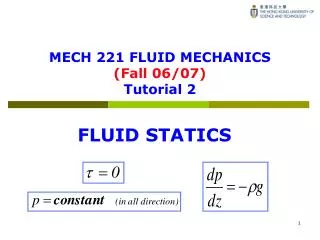
Fluid statics • the study of fluids at rest • important concepts of fluid statics: • variation of pressure intensity throughout the fluid, and • the force exerted on surfaces by the fluid • pressure intensityat any point in a fluid is the pressure per unit area AE-5-Fluid Mechanics
Fluid pressure • average pressure intensity P = F/A (9.3) whereF = normal force acting on area A (N) A = area over which force is acting (m2) P = pressure (Pa) • pressure at a point in a motionless fluid AE-5-Fluid Mechanics
pressure at the bottom of the container • F = V • F = Ah • P = Ah/A • P = h • pressure at point 2 P = (h/2) • pressure is the same at all points in the liquid that lie on the same horizontal plane AE-5-Fluid Mechanics
Unit of pressure intensity • referenced to two reference planes • absolute zero pressure (a complete vacuum) and • atmospheric pressure • Standard atmospheric pressure is • the pressure used when specifying standard conditions for calculations with gases, • it is also the pressure used to approximate the difference between a gauge pressure (錶壓) and absolute pressure (絕對壓力). AE-5-Fluid Mechanics
gauge pressure • = absolute pressure - actual atmospheric pressure • Actual atmospheric pressuremay be either above or below standard atmospheric pressure • Absolute pressure is always positive • Gauge pressure may be either positive or negative. AE-5-Fluid Mechanics
Pressure measurement • Manometers and • bourdon tube (栓管) pressure gauges AE-5-Fluid Mechanics
Manometer (壓力計) • Ps + 1h1+ 2h2 = 3h3 + 4h4 • 2 = 3 = 4 = • Ps+ 1h1 + h2 = h3 + h4 • 右肢開放至大氣 • 與大氣接觸點為 零錶壓 或 1 105 Pa 絕對壓力 AE-5-Fluid Mechanics
Example 9.1計算容器A之錶壓及絕對壓力 • h1 = 3 m • h2 = h3 = 2 m • h4 = 6 m • 流体 1: 油 (比重 0.9) and • 流体 2: 水 (比重 1.0). • 水之單位体積重 9800 N/m3. AE-5-Fluid Mechanics
(SG) (water) = oil (9.13) • PA + water (SGoil) h1 + h2water = h3water + h4water (9.14) • h2 = h3,管子 h2及 h3部分之液体相同, 9.14 式簡化為 • PA + water (SGoil) h1= h4water(9.15) • PA + (9800 N/m3)(0.9)(3 m) = (6m)(9800N/m3) • PA + 26,460 N/m2 = 58,800 N/m2 • PA = 32,340 N/m2錶壓 • 絕對壓力= Pg + 標準大氣壓力 • 絕對壓力 = 32,340 N/m2 + 100,000 N/m2 • = 132,340 N/m2 AE-5-Fluid Mechanics
Example 9.2Find the gauge pressure in vessel B (Figure 9.6) • PA = 3 105 Pa • SG1= 1 • SG2= 13.6 • h1= 3m • h2= 1 m AE-5-Fluid Mechanics
PA + h1water (SG1) = h2water (SG2) + PB 3 105 N/m2 + (3 m)(9800 N/m3)(1) = (1 m)(9800 N/m3) 13.6 + PB 3 105 N/m2 + 29,404 N/m2 = 133,280 N/m2 + PB 196,124 N/m2 gauge pressure = PB AE-5-Fluid Mechanics
圓筒容器爆破壓力(Burst Pressure) • 圓筒容器: 例如圓管及圓槽使用時常受很大內部壓力(internal pressure) • 需預測圓管及圓槽可承受之最大壓力 • 需推導出內部壓力與容器璧應力(stress)之關係 • 若容許應力(allowable stress )大於計算應力 (calculated stress), 容器可承受預期之壓力 AE-5-Fluid Mechanics
內部壓力與璧應利關係 • 流體產生之內部壓力 Fp = PDL (9.16) • 容器璧產生之抵抗力(Resistance force) Fp = 2Fw (9.17) Fw = wAw (9.18) (張應力) Fw = wttL (9.19) Fp = LDP = 2(wLtt) (9.20) • 求解得知璧應力, w = LDP/2Ltt (9.21) w = DP/2tt AE-5-Fluid Mechanics
某些無法預測之因素會影響材料應力 • 這些因素設計時必須考慮而以安全因子 (safety factor SF)表示 • 安全因子為 容許應力與設計實際應力之比值 • 大部分管線系統 (plumbing systems)安全係數為 2. 水槽(tanks)及其他容器安全係數為 1 .5 - 5 • wA/SF (9.22) AE-5-Fluid Mechanics
容許工作壓力計算 • nominal diameter = 5.08 cm; schedule 80 PVC pipe; ID = 4.93 cm; OD = 6.03 cm; SF = 2 tt = (OD - ID)/2 = (6.03 – 4.93)/2 = 0.55 cm • allowable stress in PVC is 48 M Pa. wA/SF w (48 * 106 Pa)/2 w 24 * 106 Pa • w = DP/2tt w = (4.93 cm)P/[2(0.55 cm)] 24 * 106 = (0.0493 m)P/[2(0.0055 m)] P = 24 * 106 Pa (2)(0.0055 m)/0.0493 m P = 5.35 M Pa AE-5-Fluid Mechanics
流體動力學 • Type of flow • Conservation of mass • Conservation of energy AE-5-Fluid Mechanics
Type of flow • 層流(Laminar flow) and紊流(Turbulent flow) • 層流中每一元素(element)以相同方向及相同速度移動 • 這些元素產生流線(streamlines)流線間以固定的關係移動 • 層流中不存在流線間內部漩渦(eddies)及穿越流線之移動 AE-5-Fluid Mechanics
紊流 之特性 • 穿越流線之移動, 內部漩渦, 元素間其他移動. • 紊流中能量損失比層流大, 因內部摩擦阻力大. • 層流在低流速, 小管徑及高黏滯度流體中較易發生. • 易於發生紊流之條件剛好相反. • 養殖工程應用之水流大部分為紊流 AE-5-Fluid Mechanics
質量守恆 • 密閉導管中, 通過某一段面之流體質量與通過其他段面者相等 • 質量平衡方程式 v1A11 = v2A22 (9.23) = 單位體積重 • 不可壓縮流體1 = 2 (9.24) v1Al = v2A2 (9.25) • 連續方程式(continuity equation) 由密閉管線中之不可壓縮流體推導, 但亦可應用於明渠(open channel flow)之不可壓縮流體 AE-5-Fluid Mechanics
Find the velocity of the flow at section 2 • 0.5 m3/s flowing past section 1 and the pipe diameter at section 2 is 30 cm. v1A1 = v2A2 v1A1 = Q1 Q2 = 0.5 m3/s = v2A2 v2A2 = (radius)2 v2 0.5 m3/s = v2(0.30 m/2)2 0.5 m3/s = v2(0.0707) 7.07 m/s = v2 AE-5-Fluid Mechanics
Conservation of energy • Total energy at any point in a fluid: • potential energy due to location, potential energy due to pressure, and kinetic energy due to motion of the fluid. • Potential energy due to its elevation (PE)e • weight Wdistance above the datum plane Z (PE)e1 = WZ1 (9.26) (PE)e2 = WZ2 (9.27) AE-5-Fluid Mechanics
Pressure energy • The pressure energy (PE)p is the weight of an element of fluid times its pressure. • The fluid pressure h = P/ (PE)p = (P/)W (9.28) • kinetic energy KE = (1/2)mv2 (9.29) m = W/g (9.30) KE = Wv2/2g (9.31) AE-5-Fluid Mechanics
The total energy of an element of fluid Ee Ee = ZW + (P/)W + (v2/2g)W(9.32) • By the law of conservation of energy Z1W + (P1/)W+ (v12/2g)W = Z2W + (P2/)W + (v22/2g)W (9.33) Z1 + (P1/)+ (v12/2g) = Z2 + (P2/) + (v22/2g) (9.34) • Bernoulli's equation, is applicable to flow of an idealized fluid that has no energy losses between points 1 and 2. AE-5-Fluid Mechanics
Real fluid Z1 + (P1/)+ (v12/2g)+ external energy input = Z2 + (P2/) + (v22/2g) + minor losses + pipe friction losses (9.35) • Minor losses due to internal fluid friction • (1) fluid passes through a change in cross-sectional area of the pipe, • (2) the fluid changes direction, • (3) the fluid enters or leaves a conduit, and • (4) other changes occur that increase fluid losses. • minor losses = K(v2/2g) (9.36) AE-5-Fluid Mechanics
Calculation of head loss • nominal diameter 2.54 cm; 90o elbow; flow 60 liters/min of water; inside diameter 2.43 cm. Q = Av = 60 l/min = 1liter/s 0.001 m3/s = Av = r2v v = (110-3 m/s)/[3.14((2.43/2)10-2 m)2] v= 2.2 m/s minor losses = K(v2/2g) minor losses = [0.9(2.2 m/s)2]/[2(9.8 m/s)] minor losses = 0.22 m of water AE-5-Fluid Mechanics
Frictional losses are a function of the fluid velocity, fluid density, diameter of the pipe, fluid viscosity, and pipe roughness. ff = f(v,D, , , ) (9.37) ff= friction factor v = velocity D= pipe diameter = roughness (absolute) = fluid density = fluid viscosity f= function of AE-5-Fluid Mechanics
ff = f((vD/), (/D)) (9.38) • vD/is referred to as Reynolds number • /D is the relative roughness • Nre < 2000 : laminar flow: ff = 64/Re (9.39) • Nre > 4000: turbulent flow • /D relates the height of irregularities on the internal pipe surface with the pipe diameter • values for the dimensionless parameters : Moody's diagram AE-5-Fluid Mechanics
Once the friction factor is determined, the head loss due to pipe friction can be computed h = ff (L/D)(v2/2g) (9.40) h = head loss due to pipe friction (m) ff = friction factor (dimensionless) L = length of pipe (m) D = pipe diameter (m) v= fluid velocity (m/s) g = acceleration of gravity (m/s2) AE-5-Fluid Mechanics
Head loss in a pipe • L = 100 m; nominal diameter 7.62 cm; galvanized pipe; flow 0.6 m3/min of water at 20°C; internal diameter 7.37 cm. Q = Av 0.6 m3/min = (0.0737 m/2)2 v 0.64/[3.14(0.0054)] = v 141.5 m/min = v 2.36 m/s = v Reynolds number= Re = vD/ = vD/ Kinectic viscosity of water at 20°C = 1.1 10-2 cm2/s Re =[2.36 m/s (7.37 10-2 m)]/1.1 10-6 m2/s Re = 15.8 104 AE-5-Fluid Mechanics