The Scientific Method
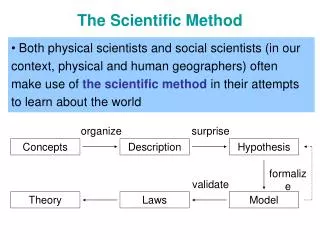
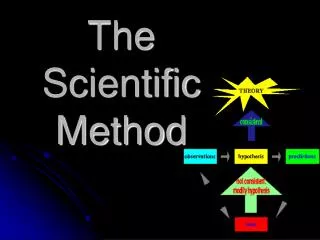
The scientific method is essential for ensuring reliable and repeatable results in scientific inquiries. It begins with identifying a clear question, followed by extensive research and the formation of an educated hypothesis. Next, scientists design and conduct experiments to test their hypotheses, carefully considering all variables. Observations during experiments help gather data, which leads to conclusions that evaluate the hypothesis and summarize findings. This structured approach allows other scientists to replicate studies and validate results, ultimately advancing our understanding of the world.

The Scientific Method
E N D
Presentation Transcript
Why do we need a method? • Scientists need a reliable system for answering questions. • The method ensures that another scientist could repeat your experiment and get the same results.
1. Identify a Question • All science experiments start with a question. • Types of Questions: • Relationships: How does one thing affect another? • Example: How does the amount of sleep affect a student’s performance in class the next day? • Investigations: Exploring a topic • Example: Which common substances dissolve in water?
2. Collect Information • Scientists do research about their question. • They read about other experiments on the same topic.
3. Form a Hypothesis • Research allows a scientist to make an educated guess to answer their question • This educated guess is called a hypothesis.
4. Design and Carry Out an Experiment • Scientists must then design and carry out an experiment that will test their hypothesis. • They must be careful to consider all variables that affect their results. • A variable is something that can be changed in an experiment (ex: temperature)
5. Do Observations • Scientists need to observe the results of their experiment. • These can be measurements, or experiences. • Examples: • The magnesium bubbled and dissolved in the acid • There were 25.2 mL of gas produced in the reaction.
6. Make Conclusions • Scientists lastly must make conclusions about their experiment. • Their conclusions do 3 things: • Look back at the hypothesis. Was it correct? • Summarize all of your findings. What did you discover? • Report your findings so that other scientists can follow your work.