
Enhancing Worker Safety: Evaluating the Pneumatic Jackhammer Lift Assist for Musculoskeletal Disorders
E N D
Presentation Transcript
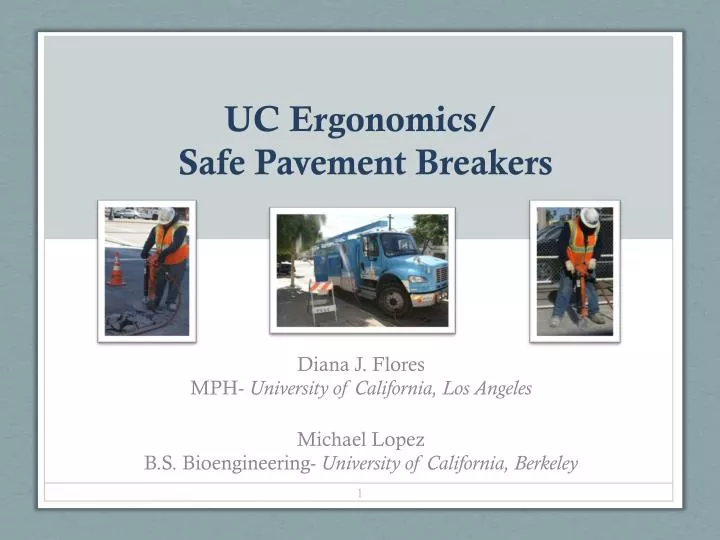
UC Ergonomics/ Safe Pavement Breakers Diana J. FloresMPH- University of California, Los Angeles Michael LopezB.S. Bioengineering- University of California, Berkeley
Background • In construction… • 5 out of every 100 workers injured • >50% of injuries = Musculoskeletal Disorders (MSDs) • Jackhammering causes back and shoulder MSDs • Stuck jackhammer = increased strain • Looking for a solution to help prevent MSDs
Background • Jackhammer Lift Assist • Pneumatically powered “foot” pushes jackhammer out of the ground • Reduces effort of lifting/repositioning jackhammer • Decreases back and shoulder strain
Background • Lift Assist available to workers at PG&E • Workers prefer not to use device
Objective • Find out why many workers prefer traditional method of jackhammering
Methods • Site visits at PG&E (2) • Worker interviews (4) • Worker Questionnaires (4) • Interviews with Ergonomist and Construction experts • Interview with PG&E union rep (IBEW 1245) • Visited Northern California Laborer’s Training Center in San Ramon
Whatwe learned THE GOOD: • Helpful on flat, open ground • Reduces back and shoulder strain • Well accepted once workers give it a try THE BAD: • Not appropriate for all situations (hills, limited space) • Decreases accuracy of work • Large reach for activation trigger • Adds 10lbs weight
Evaluation “It’s a good idea, but it needs some work” -PG&E construction worker
Recommendations • Decrease activation trigger reach • Decrease weight of device • Modify foot such that it conforms to sloped surfaces
Further Recommendations • Larger storage compartment for device • Put jackhammer away as a team when possible • Conduct periodic safety training for individual work crews on jackhammer risks and precautions. • Incorporate Lift Assist into initial jackhammer trainings
Challenges • Project time limitation • Small Sample Size • Not much literature specific to Jackhammer MSDs • Jackhammer injuries not limited to MSDs
Issues • Noise • Vibration • Road Traffic • Silica Dust
Successes • Cooperative PG&E liaisons and crews • Interviews with ergonomics and construction experts • Sufficient videotape footage • Understanding additional construction work hazards that we were not previously aware of.
Acknowledgements UC Ergonomics Lab • Maggie Robbins • Dr. David Rempel • Betsy Llosa • Staff CA. Dept. of Public Health • Dr. Bob Harrison • David Harrington • Staff Association of Occupational and Environmental Clinics Occupational Health Internship Program • Diane Bush • Sarah Jacobs PG&E • Garret Chang • TaisirShurasa • Work Crews Northern CA. Laborer’s Training Center • Ollie Hurl • Jerome Williams