Understanding the Internet: Protocols, Structure, and Communication Overview
This course begins with an in-depth exploration of the Internet, covering essential concepts such as protocols, network structure, and communication methods. Learn about the network edge, core, and access, along with physical media and performance aspects including loss and delay in packet-switched networks. Delve into the layers of protocols and service models, starting from what defines the Internet as a "network of networks." We'll also discuss the history of Internet development and the roles of various devices and applications that connect millions of users globally.

Understanding the Internet: Protocols, Structure, and Communication Overview
E N D
Presentation Transcript
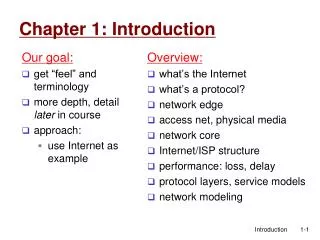
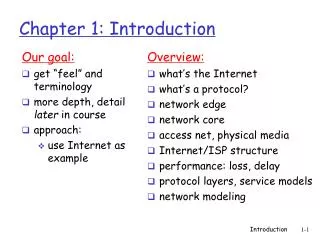
Our goal: get “feel” and terminology more depth, detail later in course approach: use Internet as example Overview: what’s the Internet what’s a protocol? network edge network core access net, physical media Internet/ISP structure performance: loss, delay protocol layers, service models network modeling Chapter 1: Introduction Introduction
Chapter 1: roadmap 1.1 What is the Internet? 1.2 Network edge 1.3 Network core 1.4 Network access and physical media 1.5 Internet structure and ISPs 1.6 Delay & loss in packet-switched networks 1.7 Protocol layers, service models 1.8 History Introduction
millions of connected computing devices: hosts = end systems running network apps communication links fiber, copper, radio, satellite transmission rate = bandwidth routers: forward packets (chunks of data) router workstation server mobile local ISP regional ISP company network What’s the Internet: “nuts and bolts” view Introduction
“Cool” internet appliances Internet gaming, chatting Web-enabled toaster + weather forecaster Radio Frequency Identification (RFID) Internet phones Introduction
protocolscontrol sending, receiving of msgs e.g., TCP, IP, HTTP, FTP, PPP Internet: “network of networks” loosely hierarchical public Internet versus private intranet Internet standards RFC: Request for comments IETF: Internet Engineering Task Force What’s the Internet: “nuts and bolts” view router workstation server mobile local ISP regional ISP company network Introduction
communication infrastructure enables distributed applications: Web, email, games, e-commerce, file sharing communication services provided to apps: Connectionless unreliable connection-oriented reliable Provide a comment playground for everyone What’s the Internet: a service view Introduction
human protocols: “what’s the time?” “I have a question” introductions … specific msgs sent … specific actions taken when msgs received, or other events network protocols: machines rather than humans all communication activity in Internet governed by protocols What’s a protocol? protocols define format, order of msgs sent and received among network entities, and actions taken on msg transmission, receipt Introduction
a human protocol and a computer network protocol: TCP connection response Get http://www.awl.com/kurose-ross Got the time? 2:00 <file> time What’s a protocol? Hi TCP connection request Hi Q: Other human protocols? Introduction