Download
1 / 17
170 likes | 308 Vues
Join Linda Miller, Director of the Centralina Area Agency on Aging, in exploring the crucial need for dementia-friendly communities. With over 272,900 seniors affected by dementia in North Carolina, understanding and addressing the challenges associated with Alzheimer's and related illnesses is essential. This initiative aims to raise awareness, support caregivers, and promote meaningful community participation. Learn how North Carolina's strategic plan is rolling out to improve the lives of those impacted and ensure an inclusive environment for all. Together, we can create a community that values sensitivity and respect.

E N D
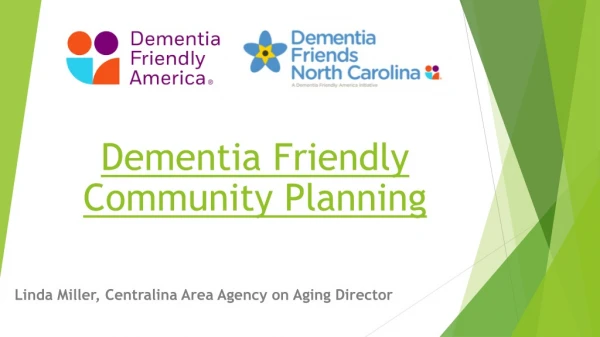
Dementia Friendly Community Planning Linda Miller, Centralina Area Agency on Aging Director
Defining Dementia & Alzheimer’s Dementia: loss of memory and other mental abilities severe enough to interfere with daily life • Alzheimer’s: • Most common form of dementia (60-80% of cases) • Symptoms include- difficulty remembering new information/memories, disorientation, mood/behavior changes, deepening confusion, unfounded suspicions, difficulty speaking, swallowing and walking • Majority of cases occur in person age 65+ • No cure, early detection and prevention important
What does this mean to you? • Personally Diagnosed • Caregiver for Family Member • Neighbors Affected • Staff or Co-workers Affected • Citizens/Clients Affected • Family • Others?
Our Region +272,900 Seniors
Dementia-Capable North Carolina • NC wrote their first strategic plan to address Alzheimer’s disease and related dementias (Completed March 2016) • Framing the Plan: • Raising awareness about dementia and transforming attitudes • Having supportive options that foster quality of life • Supporting caregivers and families touched by the disease • Promoting meaningful participation in community life • Reaching those who are underserved
Dementia-Capable North Carolina • 2016-2017 Plan Roll Out across NC • Selected sites to serve as pilots- including Charlotte Mecklenburg • Focus on using Dementia Friendly America Toolkit • NC4A purchased Dementia Friendly state license for awareness outreach and awareness • Each pilot has had multiple community events – including a “Kick Off” event, focus groups to gather local input and Dementia Friendly NC training of ‘friends”. • Attending other “age friendly” planning efforts within Centralina region to ensure that there is a “dementia friendly lens”
Age and Dementia Friendly Communities: A Comparison • “Dementia Friendly” (DF) efforts are gaining momentum • Natural extension of “Age Friendly” (AF) and DF community should have all the AF qualities in addition to the unique needs of a DF community • Following comparison is based upon the World Health Organization’s eight domains of age-friendliness alongside the key characteristics of DF communities in each of the eight domains Reference Dementia Friendly America handout
So what’s the difference between Age Friendly and Dementia Friendly anyway?
Age and Dementia Friendly Communities Reference Dementia Friendly America handout
Age and Dementia Friendly Communities Reference Dementia Friendly America handout
Age and Dementia Friendly Communities Reference Dementia Friendly America handout
Age and Dementia Friendly Communities Reference Dementia Friendly America handout
Age and Dementia Friendly Communities Reference Dementia Friendly America handout
Final Points: • Dementia Friendly and Age Friendly planning is good for all age groups. • Creating a community that increases awareness, sensitivity, and respect among members is always a good thing. • Always do “person-centered” planning and include those who you are planning for in focus groups, surveys, etc. Be inclusive! • You don’t have to have multiple efforts and can make sure planning is done through an “age friendly lens”.
Contact Information: • Linda Miller • Aging Director • Centralina Area Agency on Aging • 9815 David Taylor Drive • Suite 100 • Charlotte, NC 28262 • lmiller@centralina.org • Phone: 704-348-2712