Understanding Individual Motivation: Factors, Theories, and Implications for Success
This chapter explores the multifaceted nature of individual motivation, focusing on three key aspects: direction of decisions, persistence, and intensity. It differentiates between intrinsic and extrinsic motivation and examines the ongoing debate surrounding behaviorism. Key frameworks such as Atkinson's achievement theory and Maslow's Hierarchy of Needs are discussed, along with the significance of individual differences in motivation. The text emphasizes the role of gender in motivation and introduces Gardner's concept of Multiple Intelligences, highlighting the importance of accommodating diversity in motivational strategies and assessment.

Understanding Individual Motivation: Factors, Theories, and Implications for Success
E N D
Presentation Transcript
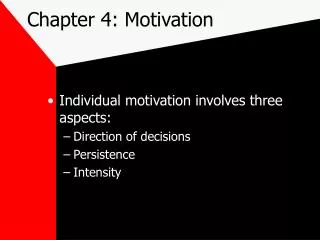
Chapter 4: Motivation • Individual motivation involves three aspects: • Direction of decisions • Persistence • Intensity
Type of Motivation • Extrinsic v. Intrinsic • What is the debate regarding Behaviorism? • What did the Western Electric Studies show regarding this debate? • Atkinson believed that people either have an intrinsic desire to achieve (n Ach) or a desire to avoid failure. How do you feel about this? Are failure avoiders ever successful? • What do you think about the Gender issue “Fear of Success?”
Differences • Individual difference and diversity are to be understood by administrators: both for motivational and assessment purposes. • Howard Gardner’s concept of Multiple Intelligences is important in understanding diversity.
“People are always motivated; in fact, they are never unmotivated.” --Arthur Combs • Abraham Maslow’s Hierarchy of Needs supports thisconcept. He indicates that we are all motivated based the most basic need that needs to be satisfied at a particular time.
From: Herzberg, F., Mausner, B., & Snyderman, B. (1959). The Motivation to Work. NY: John Wiley.
Implementing Herzberg’s Theory:Job Enrichment (Vertical Loading)