Download
1 / 16
160 likes | 317 Vues
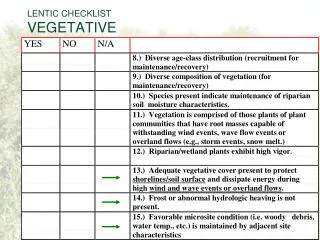
This checklist outlines key indicators for the assessment of riparian-wetland vegetation. It emphasizes the importance of a diverse age-class distribution to ensure ongoing recruitment and recovery of plant communities. The presence of various wetland indicator species and their capacity to maintain soil moisture levels is crucial for ecosystem stability. Additionally, the vigor of vegetation, adequate vegetative cover, and favorable microsite conditions are essential for protecting shorelines and dissipating energy during adverse events. Monitoring these factors contributes to the sustainable management of wetland habitats.

E N D
8. There is a diverse age-class distribution of riparian-wetland vegetation (recruitment for maintenance/recovery) • Purpose: • Determine if sufficient age classes are present to indicate recruitment is occurring • Does not mean all age-classes are present • Usually two age classes are sufficient III
Mature shrubs Young shrubs III
No Is there a diverse age class of riparian-wetland vegetation?
9. There is diverse composition of riparian-wetland vegetation (for maintenance/recovery) Alder Red osier dogwood Sedge Bulrush Cattails
10. Species present indicate maintenance of riparian-wetland soil moisture characteristics • Purpose: • Indicate the presence of a shallow water table • It does not ask if there is enough plants • Only that the plants that are there indicate the maintenance of riparian-wetland moisture conditions III
Wetland Plants Indicator Categories • Obligate Wetland (OBL) >99% in wetlands • Facultative Wetland (FACW) 67-99% • Facultative (FAC) 34-66% • Facultative Upland (FACU) 1-33% • Obligate Upland (UPL) <1% JUAR2=75 CANE2=99 POPR=50 BRTE=1 ROWO=25
11: Vegetation is composed of those plants or plant communities that have root masses capable of withstanding wind events, wave flow events, overland flows (e.g., storm events, snowmelt) • Purpose: • Do shorelines of open water areas and soil surface in seeps & wet meadows have the right plant communities? • NOT if patches are in sufficient amounts. III
12: Riparian-wetland plants exhibit high vigor • Low vigor can be illustrated by: • Relative size, productivity or reproductivity • Necrosis (tissue degeneration) • Color (chlorosis) • Wilting III
13: Adequate riparian-wetland vegetative cover is present to protect shoreline/soil surface and dissipate energy during high wind and wave events or overland flows. • Purpose: • Is there a sufficient amount of stabilizing vegetation Three-square bulrush Softstem bulrush
14: Frost or abnormal hydrologic heaving is not present • Purpose • Determine whether frost or hydrologic heaving is at a normal or aggravated rate III
15: Favorable microsite condition (i.e., woody material, water temperature, etc.) is maintained by adjacent type characteristics • Purpose • Determine if microsite conditions are necessary for proper functioning, and if so, whether adjacent site characteristics are maintaining those conditions