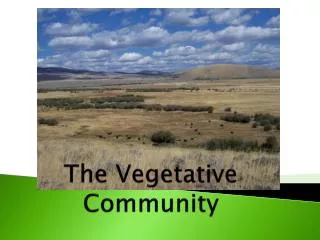
The Vegetative Community
This overview explores the components of vegetative communities, highlighting grasses, grass-likes, forbs, shrubs, and their characteristics. Grasses have jointed, hollow stems with leaves in two rows; grass-likes resemble grasses but feature solid, often triangular stems. Forbs are broad-leaved plants that die back each year, while shrubs possess persistent woody stems surviving multiple years. The text discusses native and introduced plants, seasonal growth patterns, life spans of various plants, and their growth forms, including rhizomatous, stoloniferous, and bunch types.

The Vegetative Community
E N D
Presentation Transcript
Components • Grasses-Jointed stems with leaves in two rows. Leaves are parallel veined. Stems are hollow between the joints. • Grass-likes-Look like grasses but with solid stems. Stems are often triangular. Sedges and rushes are in this category. • Forbs- Broad-leaved plants with above ground growth that dies back each year. Most forbs have net veins but a few are parallel. Broadleaf weeds and wildflowers are forbs. • Shrubs-Persistent woody stems that remain alive from one year to the next.
Shrub Grass Grass-Like Forb
Origin • Native- Plants of the original vegetation of North America. • Introduced- Plants brought from outside North America. Growth • Cool Season- Majority of growth is during cool temperatures of the spring and fall months. • Warm Season- Mostgrowth is during late spring and summer.
Life Span • Annual- Only live one season • Biennial-Live two years but only flower during the second growing season. • Perennial- Live multiple years.
Growth Form • Rhizomatous- Spread by underground stems called rhizomes. • Stoloniferous- Spread by aboveground stems called stolons. • Bunch- Spread neither by stolons or rhizomes. They grow in dense clumps.
Stoloniferous Rhizomatous Bunch
Grasses • Grasses • Complex root system that holds soil in place and preserves soil moisture • High source of nutrition for grazing animals • Light grazing benefits grass • “Graze half, leave half” • If all of the leaves are consumed, recovery of grasses takes longer
Grasses • Increaser- Varieties of grasses that thrive under heavier grazing. • Adaptations that allow them to access resources more efficiently • Often unpalatable and therefore are avoided by herbivores • Decreaser- Varieties of grasses that are easily damaged with even light grazing. • Invader- Plats that move into an area after it has been badly overgrazed. • Occasionally will move into areas that are badly undergrazed