SlideServe
Menu
Préférences
© SlideServe · v2026

A brief look at semantic networks

johana avatar
10 diapositives · 625 Views · Dec 26, 2011

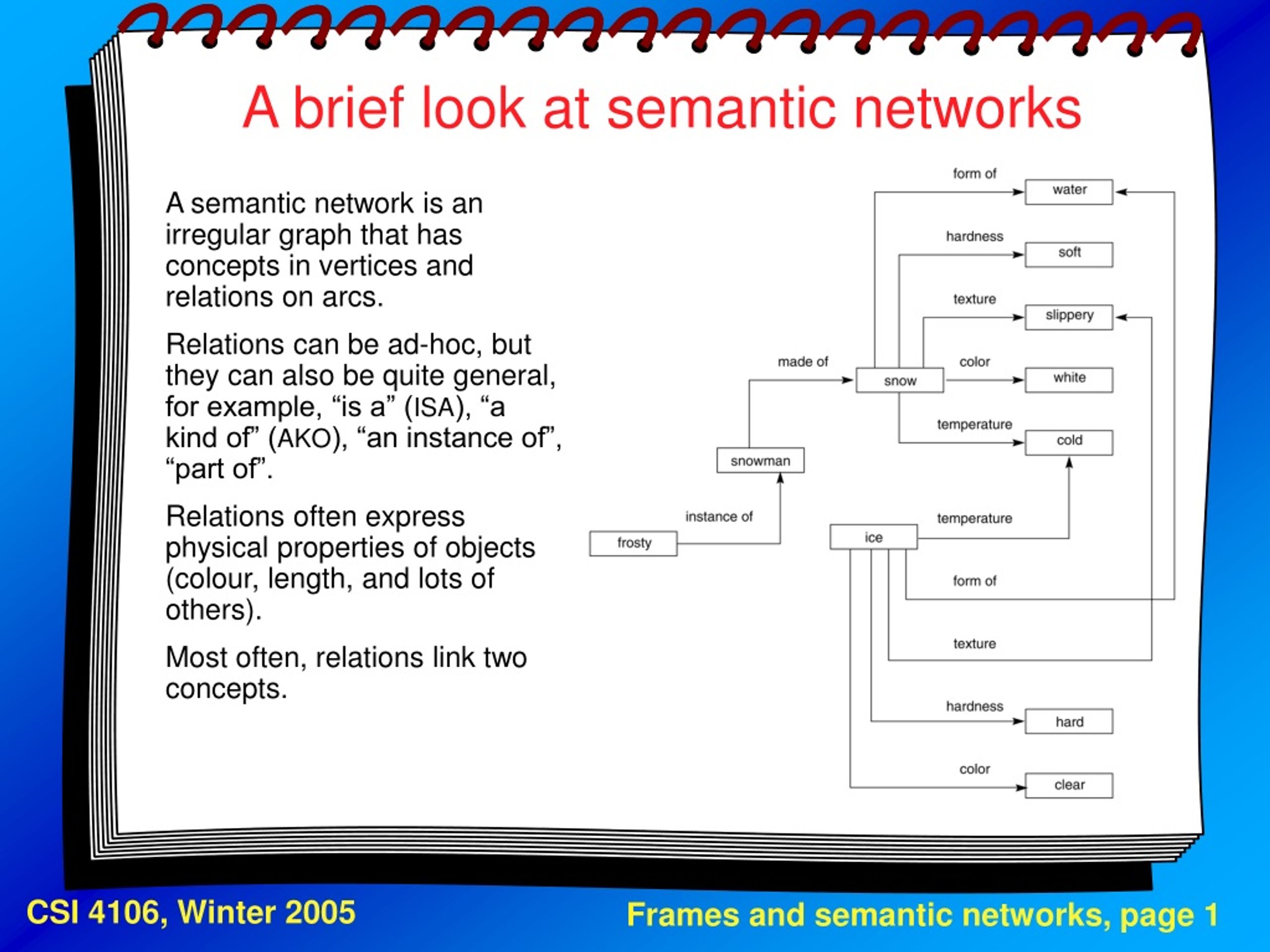
A brief look at semantic networks. A semantic network is an irregular graph that has concepts in vertices and relations on arcs. Relations can be ad-hoc, but they can also be quite general, for example, “is a” ( ISA ), “a kind of” ( AKO ), “an instance of”, “part of”.
A brief look at semantic networks - slide 1
01 / 10A brief look at semantic networks
1 / 17

Télécharger la présentation

A brief look at semantic networks
Une image / un lien ci-dessous est fourni (tel quel) pour télécharger la présentation

Politique de téléchargement : le contenu du site vous est fourni TEL QUEL pour votre information et votre usage personnel ; il ne peut être vendu, concédé sous licence ni partagé sur d’autres sites sans l’accord de son auteur.Le contenu vous est fourni TEL QUEL, pour votre information et votre usage personnel uniquement. Téléchargez la présentation en cliquant sur ce lien. Lors du téléchargement, si vous ne parvenez pas à télécharger une présentation, l’éditeur a peut-être supprimé le fichier de son serveur.Pendant le téléchargement, si vous ne parvenez pas à obtenir une présentation, le fichier a peut-être été supprimé par l’éditeur.

F I N

Plus de contenu associé

Transcription de la présentation
  1. A brief look at semantic networks • A semantic network is an irregular graph that has concepts in vertices and relations on arcs. • Relations can be ad-hoc, but they can also be quite general, for example, “is a” (ISA), “a kind of” (AKO), “an instance of”, “part of”. • Relations often express physical properties of objects (colour, length, and lots of others). • Most often, relations link two concepts.

  2. ... semantic networks (2) • General semantic relations help represent the meaning of simple sentences in a systematic way. • A sentence is centred on a verb that expects certain arguments. • For example, verbs usually denotes actions (with agents) or states (with passive experiencers, for example, “he dreams” or “he is sick”).

  3. Frames and frame systems • A frame represents a concept; • a frame system represents an organization of knowledge about a set of related concepts. • A frame has slots that denote properties of objects. Some slots have default fillers, some are empty (may be filled when more becomes known about an object). • Frames are linked by relations of specialization/generalization and by many ad-hoc relations.

  4. Parents is a 3-ary relation. Conceptual graphs • John Sowa created the conceptual graph notation in 1984. It has substantial philosophical and psychological motivation. • It is still quite a popular knowledge representation formalism, especially in semantic processing of language, and a topic of interesting research. • Conceptual graphs can be expressed in first-order logic but due to its graphical form it may be easier to understand than logic.

  5. Conceptual graphs (2)

  6. Conceptual graphs (3) Her name was Magill, and she called herself Lil,but everyone knew her as Nancy. Lil

  7. Conceptual graphs (4) Variables allow us to express the identity of an individual.

  8. Conceptual graphs (5) Specialization and type hierarchy dogs are animals (g1) A brown dog eats a bone. (g2) ... Emma, the brown animal on the porch... (g3) ... Emma, the brown dog on the porch... (g4) Emma, the brown dog on the porch, eats a bone. The challenge is to get this from text!

  9. Conceptual graphs (6) Beyond first-order logic Inheritance

  10. Conceptual graphs (7) Negation and quantification Two simple puzzles