Download
1 / 3
30 likes | 135 Vues
Explore how genes regulate metabolic pathways, the impact of genetic mutations, and the case of phenylketonuria (PKU) where phenylalanine buildup can lead to brain damage. Learn about PKU testing, management, and the importance of a low-phenylalanine diet.

E N D
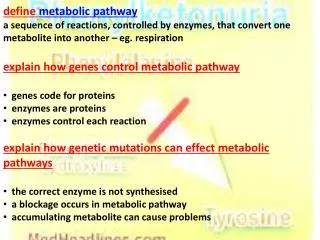
define metabolic pathway • a sequence of reactions, controlled by enzymes, that convert one metabolite into another – eg. respiration • explain how genes control metabolic pathway • genes code for proteins • enzymes are proteins • enzymes control each reaction • explain how genetic mutations can effect metabolic • pathways • the correct enzyme is not synthesised • a blockage occurs in metabolic pathway • accumulating metabolite can cause problems
discuss the genetic disorder phenylketonuria (PKU) • phenylalanine and tyrosine are amino acids obtained from protein in the diet • phenylalanine is normally converted to tyrosine • in PKU sufferers a mutation occurs in the gene that codes for the enzyme • phenylalanine is not converted to tyrosine
phenylalanine accumulates in the blood • brain damage can result • 1 in 10,000 people suffer from PKU • all babies are tested for PKU a few days after birth • no treatment exists • must stick to a low phenylalanine diet • receive regular blood tests