
SlideServe
Menu
Préférences
© SlideServe · v2026

EQUINE ENCEPHALOMYELITIS

jolene avatar
11 diapositives · 900 Views · Mar 07, 2014

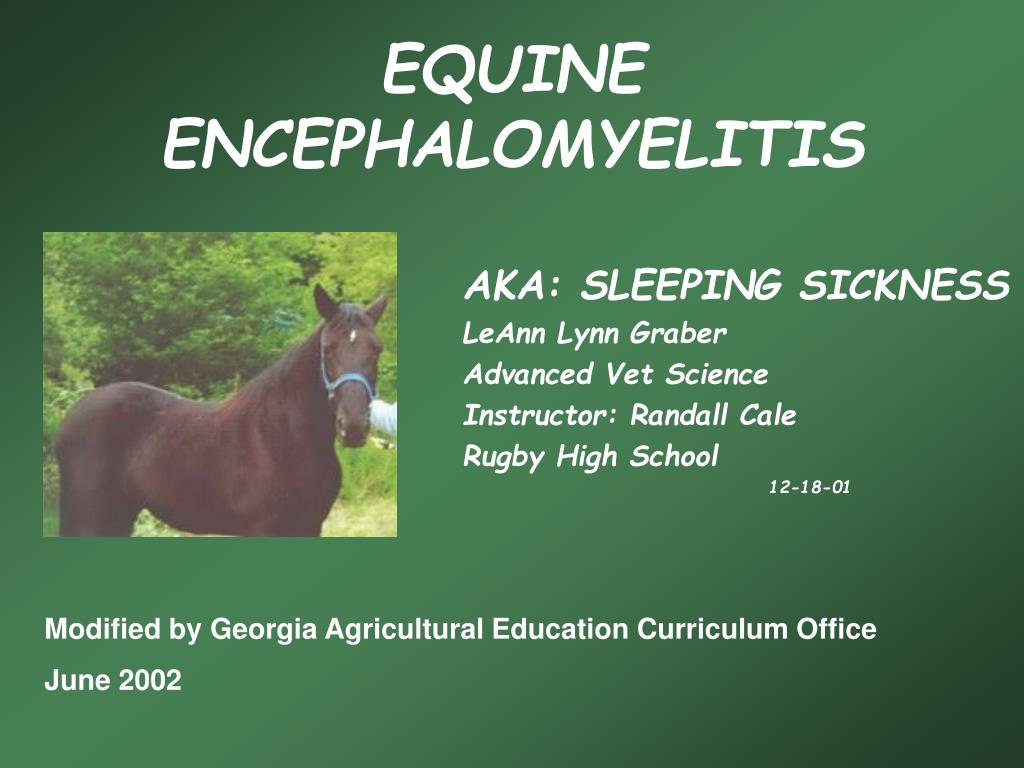
EQUINE ENCEPHALOMYELITIS. AKA: SLEEPING SICKNESS LeAnn Lynn Graber Advanced Vet Science Instructor: Randall Cale Rugby High School 12-18-01. Modified by Georgia Agricultural Education Curriculum Office June 2002. What is Equine Encephalomyelitis??? AKA: Sleeping Sickness.
EQUINE ENCEPHALOMYELITIS - slide 1
01 / 11EQUINE ENCEPHALOMYELITIS
1 / 17

Télécharger la présentation

EQUINE ENCEPHALOMYELITIS
Une image / un lien ci-dessous est fourni (tel quel) pour télécharger la présentation

Politique de téléchargement : le contenu du site vous est fourni TEL QUEL pour votre information et votre usage personnel ; il ne peut être vendu, concédé sous licence ni partagé sur d’autres sites sans l’accord de son auteur.Le contenu vous est fourni TEL QUEL, pour votre information et votre usage personnel uniquement. Téléchargez la présentation en cliquant sur ce lien. Lors du téléchargement, si vous ne parvenez pas à télécharger une présentation, l’éditeur a peut-être supprimé le fichier de son serveur.Pendant le téléchargement, si vous ne parvenez pas à obtenir une présentation, le fichier a peut-être été supprimé par l’éditeur.

F I N

Plus de contenu associé

Transcription de la présentation
  1. EQUINE ENCEPHALOMYELITIS AKA: SLEEPING SICKNESS LeAnn Lynn Graber Advanced Vet Science Instructor: Randall Cale Rugby High School 12-18-01 Modified by Georgia Agricultural Education Curriculum Office June 2002

  2. What is Equine Encephalomyelitis??? AKA: Sleeping Sickness • Equine Encephalomyelitis is a virus that affects the nervous system. • Wild animals and birds act as reservoirs. • Can also affect humans.

  3. CAUSES AND TRANSMISSION • Transmitted by biting insects “mosquitoes” Or other hematophagous insects.

  4. THREE TYPES OF EQUINE SLEEPING SICKNESS • Eastern Equine Encephalomyelitis (EEE) • Venezuelan Equine Encephalomyelitis (VEE) • Western Equine Encephalomyelitis (WEE)

  5. Eastern Equine Encephalomyelitis • Found in western hemisphere • Principal animals infected: wild birds domestic fowl horses mules donkeys • Means of spread to man: mosquitoes

  6. Venezuelan Equine Encephalomyelitis • Found in Western hemisphere • Principal animals infected: rodents and equis • Means of spread to man: mosquitoes

  7. Western Equine Encephalomyeitis • Found in Western and central U.S.A., Canada, South America • Principal animals infected: Wild birds domestic fowl horses mules donkeys bats reptiles amphibians • Means of spread to man: mosquitoes

  8. Signs & Symptoms • Signs and symptoms occur about 5 days after infection. • Look for signs of fever, impaired vision, irregular gait, wandering, reduced reflexes, circling, lack of coordination, yawning, grinding of teeth, occasional convulsions,and death.

  9. Treatment • No treatment is available. But anti-inflammatory drugs, control of seizures and intensive nursing care will aid in the recovery of mild cases. • Most effective way to treat is to quarantine the animal.

  10. Prevention • Use highly effective vaccines before the mosquito season

  11. BibliographyAiello,Susan E. Ed.The Merck Veterinary Manual.Whitehouse Station, N.J.: Merck and Co. Inc., 1998.