Exploring the Scientific Method: Inquiry Process in Science
Discover the essence of the scientific method, the heart of science, through repeatable observations and testable hypotheses. Learn about the two types of science - Discovery science and Hypothesis-based science - and the ordered steps involved in scientific inquiry. Gain insights into observation, hypothesis formation, experiment design, data collection, and theory development. Understand the significance of inductive and deductive reasoning in scientific investigation. Explore examples, variables, controlled experiments, data types, and units of measurement used in the scientific process.

Exploring the Scientific Method: Inquiry Process in Science
E N D
Presentation Transcript
Chapter 3: Scientific Method MDM NUR DIANA BT MAMAT@MOHAMAD LECTURER OF BIOLOGY
INTRODUCTION • Science • Latin word: mean “to know” • Process of inquiry that includes repeatable observations and testable hypotheses • “heart of science” • People asking questions about nature and believing that those questions are answerable
Scientific method • Series of ordered steps • Two type: • Discovery science • Hypothesis-based science /hypothetico-deductive science
Discovery science • Describing natural structure and processes as accurately as possible through careful observation • Led to important conclusion based on type of logic: it called inductive reasoning • Inductive conclusion : generalize the summarizes a large number of specific observation
Example : • Leaf is green. All leaves are green • Rose is red . All roses are red • Leaf have chlorophyll. Leaf is green All leaves have chlorophyll
Hyphotesis = tentative answer or trial explanation • Deductive reasoning • usage of deductive logic to test the hypothesis • Use the general observation to reach specific conclusion • General idea->result
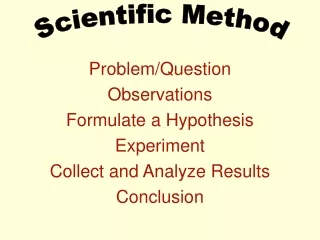
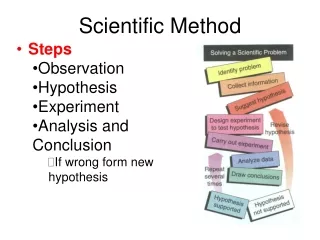
Main step of scientific method Observation Question Hypothesis Prediction Experiment Suggest further experiment Result Result did not support hypothesis Develop theory Result support hypothesis Conclusion
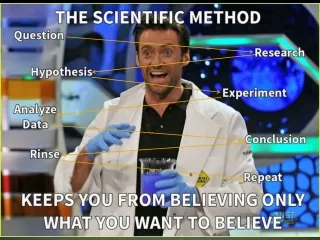
Observation • What you see • Recognize problem • Question • What you want to know • Hypothesis • Tentative answer for some question • Proposed explanation that is testable • Prediction • Logical consequence of hypothesis
Experiment • Having TWO group • Experimental group • 2 group • Test differently • Control group • Standard for comparison with one or more experimental group • example : • Mice in group A (control group) drink distilled water • Mice in group B (experimental group) drink water with drug X • Mice in group C (experimental group) drink water with drug Y
Variable • Can be change • 3 types • Independent (manipulated) • condition or event under study • Set up • E.g : 2km,4km,6km • Dependent • Condition or event that may change due to the independent variables • Eg : result • Controlled • All the other condition and events that investigators attempt to keep the sum
Theory • An explanation that is broad in scope, generates new hypothesis and supported by large of evidence
Data • Recorded observation • 2 types of data • Qualitative data • Recorded description • Using note, camera etc • E.g. : Jane recording her observation of monkey behavior during field search
Quantitative data • Recorded the measurement (numerical) • Height of building • Weight of animal
Unit of measurement • 1 µm= 0.01 mm • 1nm=0.001µm • 1mm=1000µm=1000000nm
Weight – kg,g • Temperature- ⁰C ⁰C = 5/9 (⁰F-32) • Concentration – mg/L,µg/L • Volume of liquid – liter,mL