Scientific Method
Explore the scientific method, organic compounds, enzymes, cellular structures, and processes like photosynthesis and cellular respiration. Learn about chemical bonds, cell division, and more in this comprehensive guide.

Scientific Method
E N D
Presentation Transcript
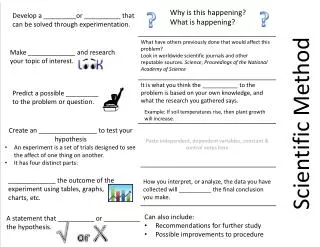
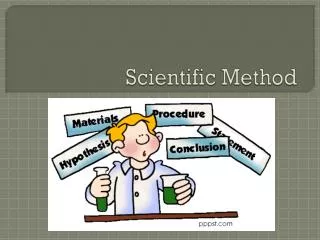
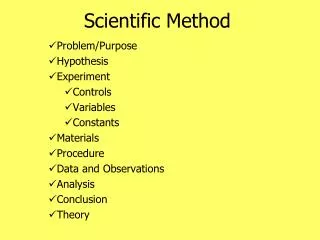
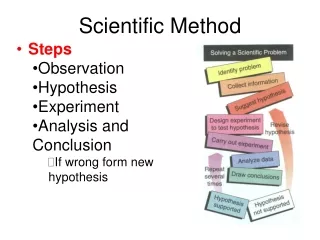
Scientific Method • Steps • Observation • Hypothesis • Experiment • Analysis and Conclusion • If wrong form new hypothesis
Scientific Method • Controlled experiment • Tests effect of a single variable while keeping all other variables the same • Any observed differences should be caused only by the single changed variable
Scientific Method • Observations • (qualitative and quantitative) • Quantitative– involve numbers, counting, measuring objects. • Qualitative– involve characteristics that cannot be easily measured or counted such as color or texture
Scientific Method • Hypothesis– a possible explanation, a preliminary conclusion, or even an “educated” guess about some event in nature • Theory– As evidence builds up, a particular hypothesis may become so well supported that scientists consider it a theory. Atomic theory
Chemistry • Organic Compounds • Carbohydrate-main source of energy for animals • Monomer = monosaccharide (single suger) • Polymer = Starch, Cellulose • Protein-functional or structural • Monomer = Amino Acid • Polymer = Protein • NucleicAcid-controls inheritance • Monomer = Nucleotide • Polymer = DNA, RNA
Chemistry • Enzymes • Biological Catalyst • Speeds up chemical reactions • Lowers Activationenergy (energy needed to get reaction started • Not used up during reaction • A specialized protein • functional protein
Chemistry • pH • Measured on a scale of 1-14 • Below 7 acid • Above 7 base • pH of 7 = neutral • Speeds up chemical reactions • Lowers Activation energy (energy needed to get reaction started
Chemistry ReactantsandProducts Reactants Products
Chemistry • Solutions • Solute-“stuff” that is dissolved • Solvent –the liquid that does the dissolvin
Chemistry Chemical bonds– links that hold atoms together. Two main types Covalent bonds– formed by sharing electrons between two atoms • Bond found in organic compounds
Chemistry Ionic bonds- formed by transfer of 1 more electrons from 1 atom to another • Ion– (+) or (-) charged atom that results from gaining or losing electron
Cells • Organelles
Nucleus- control center of cell. Contains DNA (genetic material). Found in eukaryotic cells.
Ribosome- organelle where proteins are made. Free-floating and some on Endoplasmic reticulum
Endoplasmic reticulum- Cells transport system. Help make proteins (rough E.R.)
Lysosome- “clean-up” crew of cell. Contains enzymes to break down old cell parts, digest food, etc.
Cell membrane- flexible, and semi-permeable membrane surrounding cell.
Cells • Cell membrane- composed of lipid bi-layer (2 layers of lipids) Lipid layer also called phospholipids
Cells • Semi-permeable- allows some things to pass through but not others Diffusion- movement from areas of high concentration to areas of low concentrations Osmosis- diffusion of water
Cells • Active transport-takes energy (endocytosis and exocytosis) • Passive transport-no energy required (diffusion and osmosis)
Cells Prokaryotes and Eukaryotes- Scientists divide cells Into two groups depending on whether they have a nucleus or not. 1. Prokaryotes-nonucleus • Smaller and simpler than cells of eukaryotes • Do have cytoplasm and cell membrane • Example: Bacteria
Cells Eukaryotes- do contain nucleus and membrane bound organelles (includes plants, animals, fungi) • Contain cytoplasm and cell membrane • Contains organelles
Cells Homeostasis-maintain constant internal conditions (example: blood sugar levels, blood pressure, shivering/sweating)
Photosynthesis • Equation • Energy from sunlight converts carbon dioxide and water into high energy sugar (glucose) • Takes place in chloroplast (organelle) • Affected by: • 1. Light intensity • 2. Amount of water • 3. Temperature • Autotroph-Can make their own food (plants) light 6CO2 + 6H2O C6H12O6 + 6O2
Cellular Respiration • Heterotroph- can not make their own food. Need to eat something else to obtain energy (fungi, animals, most bacteria • Equation • Fermentation- still make energy when no oxygen present. Two types: alcoholic and lactic acid fermentation • Mitochondria-where respiration takes place 6O2 + C6H12O6 6CO2 + 6H2O + Energy
Cellular Respiration Series of events: Glycolysis → krebs cycle →electron transport ENERGY
Cellular Respiration Compared to Photosynthesis
Cell Division Cell cycle- series of event cell goes through as it grows and eventually divides. Interphase- When cell grows and develops, getting ready to divide again Mitosis-Division of cell nucleus (forms diploid (2N) cells) Cytokinesis-cell splits in two PMAT
Cell Division • Meiosis- cell division forming sex cells (gametes) • Results in 4 genetically different cells • Gametes are N (haploid-half the number of chromosomes)
Cell Division • Cell growth (cell gets bigger, volume increases faster than surface area) so has to divide
DNA, RNA, and Protein Synthesis • Replication- DNA making DNA • Transcription- DNA making RNA • Translation- RNA making Proteins
DNA, RNA, and Protein Synthesis DNA-double helix 3 kinds ofRNA
DNA, RNA, and Protein Synthesis • Complementary bases • DNA: C-G A-T • RNA: C-G A-U
DNA, RNA, and Protein Synthesis Codon- three letter “word” on mRNA specifying a particular amino acid anticodon codon
Genetics • homozygous same letters (TT or tt) • heterozygous different letters (Tt) • Genotype- the alleles (letters) i.e. Tt, TT, tt • Phenotype- physical characteristics (Tall, short)
Genetics • Gamete- sex cell (N) haploid. • Zygote-fertilized egg • Fertilization-process when sperm and egg join
Genetics • Dominant / Recessive cross-one allele is dominant over another. I.e. T-tall (dominant) over t-short (recessive) TT X tt gametes T T All tall offspring t t
Genetics • Incomplete dominance-one allele is not completely dominant over another (RR-red crossed with WW-white yields all RW-pink flowers) RR X WW R R W W
Genetics • Co-dominance-both alleles are dominant. RR-red hair, WW-white hair, RW-roan RR X WW R R W W
Genetics • Dihybrid cross-Mendel’s two-factor experimental results were very close to 9:3:3:1 ratio predicted by punnett square. Proved that genes that segregate independently do not influence each other’s inheritance. • Principle of Independent Assortment 9:3:3:1
Genetics • Multiple Alleles-ABO blood type is an example. A and B or co-dominant.
Genetics • Crossing over- when “legs” of chromosomes cross over each other during meiosis and exchange parts of themselves.
Genetics • Non-disjunction- when chromosomes fail to separate during meiosis. Resulting in missing or extra chromosomes in gametes
Genetics • “Code of Life”-Reading codons and the amino acids they code for Example: CGA UGC AAU Arg – Cys - Asn
Genetics • Cloning-a member of a population of genetically identical cells produced from a single cell
Genetics Human Chromosomes- body cells contain 46 chromosomes (23 from sperm, 23 from egg. Join in diploid zygote) • Karyotype- picture of chromosomes cut out from photographs and grouped together in pairs • Sex chromosomes- two of 46- these determine sex of individual XX=female and XY=male • autosomes- remaining 44 chromosomes
Genetics Egg cells contain a single X chromosome. Sperm cells contain either one X chromosome or one Y chromosome. Approximately half of the zygotes are XX (female) and half XY (male)