Chapter 26 Sound
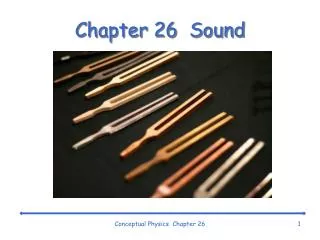
Chapter 26 Sound. Conceptual Physics Hewitt, 1999 Bloom High School. 26.1 The Origin of Sound. All sound produced by vibration of an object Strings in instrument, reed in a sax, etc. Pitch - how our anatomy interprets frequency (tone or note) Human range 20-20,000 Hertz

Chapter 26 Sound
E N D
Presentation Transcript
Chapter 26Sound Conceptual Physics Hewitt, 1999 Bloom High School
26.1 The Origin of Sound • All sound produced by vibration of an object • Strings in instrument, reed in a sax, etc. • Pitch- how our anatomy interprets frequency (tone or note) • Human range 20-20,000 Hertz • Infrasonic- frequencies <20 Hertz • Elephants, whales, earthquakes • Ultrasonic- frequencies >20,000 Hertz • Plastic welding, jewelry cleaning, mixing
26.2 Sound in Air • Sound travels in longitudinal waves • Compression- molecules pushed together represent a crest • Rarefraction- molecules pulled apart represent a trough
Rubens Tubes • Uses a flammable gas in a metal tube to show how frequency and wavelength are related to compressions and rarefractions • http://www.youtube.com/watch?v=FOYXomUFyb8
26.3 Media that Transmit Sound • Sound needs something to compress to transmit energy • Gases- air, usually • Liquids- water (whale and dolphin communications) • Solids- earthquakes, railroad tracks • Sound cannot travel in space • Ever hear the Death Star explode?
26.4 Speed of Sound • Speed of sound is dependant on how close the molecules are • The closer they are, the faster the speed • Solids- fastest • Liquids- fast • Gases- slowest • Temperature dependant- the faster the molecules are moving, the faster the speed of sound • v=330m/s + (T)(0.6m/°Cs) • Speed of sound in air, T=temperature in °C • v=d/t (still and always)
26.5 Loudness • Loudness- how our anatomy interprets amplitude (volume) • Decibel (dB)- 1/10th of a bel • Each level 10 times as loud as the prior level
26.6 Forced Vibrations • Forced vibrations- a non-vibrating object that vibrates as a result of other vibrations • Tuning fork alone vs. tuning fork on a tabletop
26.7 Natural Frequency • Natural frequency- depends on material, elasticity of object, shape of object • Small brass bell vs. large brass bell • Baseball bat vs. wrench dropped on the floor • Champagne glass
28.8 Resonance • Resonance- when the frequency of a forced vibration matches a natural vibration • Kicking your legs while swinging to go higher • Increase in amplitude (loudness) • Crest overlaps with crest • Tacoma Narrows Bridge Collapse
26.9 Interference • Interference- waves from two separate sources overlapping • Constructive interference- the crest of one wave overlaps with the crest of another wave • Increases amplitude (loudness) • Destructive interference- the crest of one wave overlaps with the trough of another wave • Decreases amplitude (loudness) • http://www.falstad.com/interference/
26.10 Beats • Beats- the periodic variation in loudness • Caused by the interference of two slightly different frequencies • www.sciencejoywagon.com/explrsci/media/tonebeat.htm • Used to tune instruments • C:\Program Files\Wolfram Research\Mathematica Player\7.0\MathematicaPlayer.exe