Download
1 / 10
100 likes | 213 Vues
The CRaTER instrument aboard the LRO mission measures the effects of galactic cosmic rays (GCR) and solar energetic protons (SEP). While GCRs are consistently low, large SEP events are infrequent and follow a solar cycle pattern. As mission duration increases, the signal-to-noise ratio improves, enhancing the LET spectrum data quality. Launching during the rising phase of the solar cycle reduces the chance of observing large SEP events. An extended mission duration significantly increases the likelihood of capturing large energetic proton events, crucial for understanding space radiation.

E N D
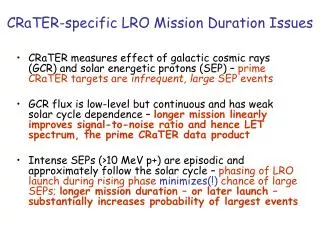
CRaTER-specific LRO Mission Duration Issues • CRaTER measures effect of galactic cosmic rays (GCR) and solar energetic protons (SEP) – prime CRaTER targets are infrequent, large SEP events • GCR flux is low-level but continuous and has weak solar cycle dependence – longer mission linearly improves signal-to-noise ratio and hence LET spectrum, the prime CRaTER data product • Intense SEPs (>10 MeV p+) are episodic and approximately follow the solar cycle – phasing of LRO launch during rising phase minimizes(!) chance of large SEPs; longer mission duration – or later launch – substantially increases probability of largest events
SEP event occurrence varies with the solar cycle in anti-phase with weaker galactic cosmic ray fluxes (plot courtesy R. Mewaldt, Cal Tech) SEP events • At solar minimum: • Min SEP occurrence • Max GCR flux GCR Solar Minimum
LRO Launch: Currently Predicted for Rising Phase Of Cycle 24
LRO Mission Timeline: Mapped to Previous Two Solar Cycles Cycle 24 Cycle 23 Cycle 22 October 2008 June 1998 January 1988 October 2009 June 1999 January 1989 LRO Launch – rising phase of Cycle 24 Previous Solar Min Next Solar Min Δt Δt One year 2010 Hathaway, Wilson, and Reichmann J. Geophys. Res.104, 22,375-22,388 (1999)] http://science.msfc.nasa.gov/ssl/pad/solar/predict.htm
Probability of Large SEP Events During LRO: Survey of Previous Two Solar Cycle’s Energetic Proton Events – 1987 to 2003 Event definition used: - Event onset: flux exceeds a threshold for 3 consecutive 5-min average points - Event end: flux remains below threshold for 6 hours • Threshold Values: • - 10 pfu (1/(cm2 s sr)) for >10 MeV protons • 5 pfu for >50 MeV protons • - 1 pfu for >100 MeV protons
Satellites used: • - GOES 7: 1987 - 1995 • GOES 8: 1995 – 2002 • GOES 10: 1998 – 2003 • GOES 11: 2003 • Priority for satellites: GOES 8, GOES 11, GOES 10 Total number of events: >10 MeV: 153 >50 MeV: 56 >100 MeV: 53
>10 MeV Events With Flux Exceeding 10 pfu Annual Fluence (*) (cm2 sr)-1 ~5 – 7 “during” LRO Mission in Cycles 22 and 23 Number of Events (*) Caution: Units aren’t quite right!
>50 MeV Events With Flux Exceeding 5 pfu Annual Fluence (cm2 sr)-1 ~0 - 4“ during” LRO Mission in Cycles 22 and 23 Number of Events
>100 MeV Events With Flux Exceeding 1 pfu Annual Fluence (cm2 sr)-1 ~0 – 3 “during” LRO Mission in Cycles 22 and 23 Number of Events
Estimated Range of Number of Events as a Function of Mission Duration (assuming an October 2008 LRO launch; ranges based on Cycles 22/23) • 12-month mission may yield NO large events! • 18-month mission provides higher confidence of seeing at least a few large events • Multi-year mission extended into solar maximum assures excellent coverage of even large events