Central Nervous System
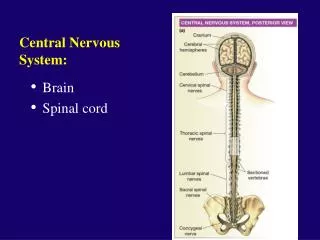
The Central Nervous System (CNS) comprises the brain and spinal cord, playing a pivotal role in controlling sensory experiences, actions, thoughts, and memory. Neurons, the fundamental units of the CNS, consist of three parts: cell body, dendrites, and axons. There are three types of neurons: sensory, motor, and inter-neurons. The brain, weighing approximately 2-3 lbs, is divided into four lobes: frontal, parietal, occipital, and temporal, each responsible for various functions. The peripheral nervous system connects the CNS to the body’s nerves, including both somatic and autonomic divisions.

Central Nervous System
E N D
Presentation Transcript
Central Nervous System Health Mrs. Wagner
Neurons • Carry nerve messages or impulses from one part of the body to another (NC) • 3 Parts • 1. Cell Body – controls cell growth • 2. Dendrite – carry nerve impulses to cell body • 3. Axon – carries impulses away
3 Types of Neurons • 1. Sensory – external/internal environment • 2. Motor – muscles and glands • 3. Inter-neurons – brain and spinal cord
Nerve Impulse • Dendrites stimulated impulse travels to cell body away from cell body on axon cross synapse
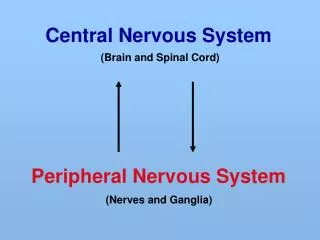
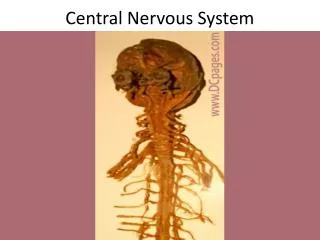
Central Nervous System • 2 Parts • 1. Central Nervous System – brain and spinal cord • 2. Peripheral Nervous System – nerves that connect brain and spinal cord
Brain • 2 ¼ - 3 ¼ lbs. • Controls sense experiences, actions, thoughts and memory • 2 Hemispheres – right and left
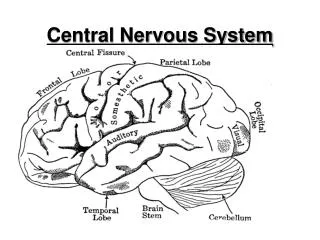
3 Areas of the brain • 1. Cerebrum – contains specialized regions – 85% brains weight – cross wired L-R and R-L (NC) - Frontal Lobe – middle of forehead to middle of head – moves arms & legs, judgment, logic, problem solving and planning (NC) - Parietal Lobe – middle lobe – sensory, images, touch, pressure, pain, temperature (NC)
- Occipital Lobe – back of head – vision and reading ability (NC) - Temporal Lobe – Above ears, U-Shaped, hearing and memory, complex sensory patterns (dance interpretation) (NC) • 2. Cerebellum – coordination of muscle activity: Walking (balance, movement of legs, vision) – not cross wired R-R, L-L
3. Brain stem – controls heartbeat, breathing and blood pressure and reflexes (NC) Spinal Cord • Contains meninges and cerebrospinal fluid. Nerve impulses travel from brain, down the spinal cord and out of the body – same back up (NC)
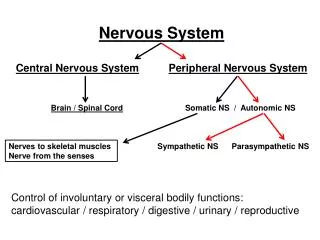
Peripheral Nervous System • Somatic – all nerves that are not the CNS (NC) • Autonomic – Internal organs (NC)