Download
1 / 10
130 likes | 291 Vues
This overview explores the Central Nervous System (CNS), comprising the brain and spinal cord, and the Peripheral Nervous System (PNS), which includes nerves and ganglia. The Somatic Nervous System (SNS) governs voluntary muscle movements via one motor neuron to skeletal muscle, using acetylcholine (ACh) as a neurotransmitter. In contrast, the Autonomic Nervous System (ANS) controls involuntary functions, utilizing two motor neurons to target cardiac muscle, smooth muscle, and glands, and employs various neurotransmitters like ACh and norepinephrine (NE).

E N D
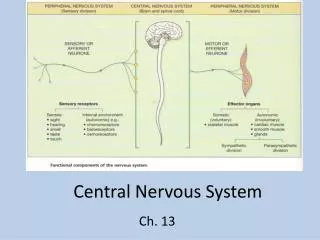
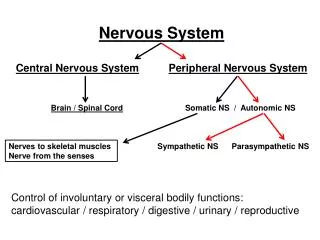
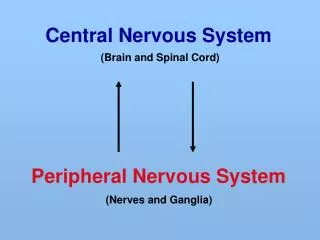
Central Nervous System (Brain and Spinal Cord) Peripheral Nervous System (Nerves and Ganglia)
Somatic N.S. Autonomic N.S. Peripheral Nervous System Skeletal Muscle Parasympathetic Division Sympathetic Division Cardiac, Smooth Muscle and Glands
Somatic Nervous System (SNS) CNS One motor neuron to a single effector tissue: Effector Tissue 1. Skeletal muscle Autonomic Nervous System (ANS) Two motor neurons to many effector tissues: Effector Tissue 1. Cardiac muscle 2. Smooth muscle 3. Glands
Somatic Nervous System (SNS) One Motor Neuron to Single Effector Tissue skeletal muscle Effector Tissue is Skeletal Muscle (released from somatic motor neurons) Neurotransmitter is ACh Receptors are Nicotinic (response is always excitatory) Control is Voluntary (except reflexes)
Autonomic Nervous System (ANS) Two Motor Neurons to Many Effector Tissues 1. cardiac 2. smooth 3. glands Effector Tissue is Cardiac and Smooth Muscle and Glands Neurotransmitters are ACh and NE (released from autonomic neurons) Receptors are Nicotinic and Muscarinic Parasympathetic: Sympathetic: Receptors are Nicotinic,Alpha () and Beta () Preganglionic fibers myelinated; postganglionic are non-myelinated Control is Involuntary (except biofeedback)
Autonomic Pathways Somatic