Central Nervous System
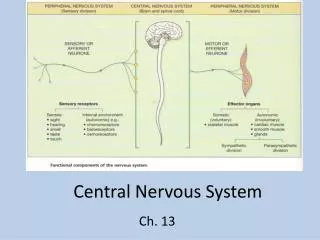
The Central Nervous System (CNS) processes information from various sensory receptors, including interoceptors, proprioceptors, and exteroceptors. It consists of the brain and spinal cord, surrounded by protective layers: dura mater, arachnoid, and pia mater. The spinal cord is crucial for reflexes and communication between the brain and body, featuring gray matter (nerve cells) and white matter (nerve tracts). Understanding the hindbrain, midbrain, and forebrain structures highlights their roles in vital functions such as respiration, movement, and sensory processing.

Central Nervous System
E N D
Presentation Transcript
CNS Receives Information • Interoceptors – sensory receptor that responds to … • Proprioceptor – respond to limb position, joint angles, and … • Exteroceptors – sensory receptor that responds to stimuli in …
The CNS Layout Fig. 16.25
The CNS Layout • Remember, CNS is hollow • Central canal in spinal cord enlarges into ventricles within … • Cerebrospinal fluid produced by ependymal cells in… • CSF …
The CNS Layout • Brain and spinal cord surrounded by… • Dura mater – outermost layer • Arachnoid – middle layer; CSF flows underneath in subarachnoid space • Pia mater – innermost layer; contains blood vessels to supply … • This is for mammals, but other vertebrates have less, with fishes having only one
The CNS Layout Fig. 16.26
Spinal Cord • Gray matter – nerve cells in the core • Dorsal horn – receives … • Ventral horn – • Largely for …
Spinal Cord – Reflexes Also send and receive information to and from … Association neurons transmit information to … Fig. 16.28
Spinal Cord • Gray matter – nerve cells in the core • Dorsal horn – receives incoming sensory info • Ventral horn – motor neurons • Largely for reflexes • White matter – outer nerve cells linking spinal cord areas and spinal cord to brain • Ascending tracts – sensory impulses • Descending tracts – motor impulses
Spinal Cord Fig. 16.30, see also Table 16.6
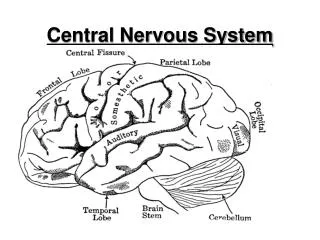
Brain • Hindbrain: medulla oblongata, pons, cerebellum • Midbrain: tectum, tegmentum • Forebrain: cerebrum (telencephelon), diencephalon Fig. 16.32
Hindbrain • Medulla oblongata – largely reflex actions • Houses nuclei of many cranial nerves • Ascending & descending pathways go through en route … • Controls many visceral and proprioreceptive reflexes: respiration, heartbeat, intestinal motility • Pons – enlargement of hindbrain of mammals; info from …
Hindbrain • Cerebellum: involuntary actions • Modifies motor output, but does not … • Processes touch, vision, auditory, proprioception, motor input • Important for maintaining balance and … • Refines motor actions by links to motor control centers
Midbrain • Tectum– roof of midbrain; receives visual and auditory input • Tegmentum – floor of the midbrain; motor output via … • Very prominent in fishes, many amphibians
Forebrain • Diencephalon: • Epithalamus – roof of diencephalon; … • Hypothalamus – regulates physiological homeostasis (temperature, water balance, appetite, metabolism, sexual behavior, etc.); stimulates … • Ventral thalamus – • Dorsal thalamus – integrates …
Forebrain • Dorsal thalamus • Receives sensory input from … • Transmits directly to … • All somatic and visceral sensory tracts (except olfactory) go … Fig. 16.41
Forebrain • Telencephalon = cerebrum • Pair of expanded lobes = • Cerebral cortex = outer wall of hemispheres • Subcortical region = rest of cerebral tissue • Consists of dorsal pallium and ventral subpallium
Telencephalon Fig. 16.42
Telencephalon Evolution Fig. 16.43