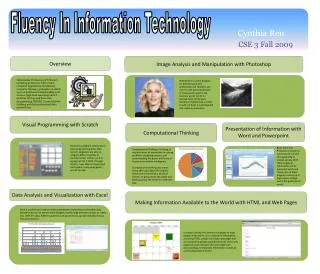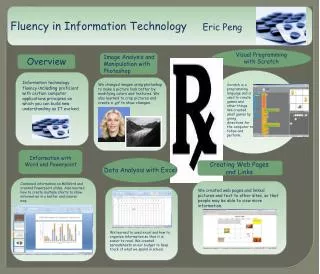
Understanding FITness in Information Technology: A Comprehensive Introduction to IT Fluency
80 likes | 211 Vues
This course, CMPT 109 at Montclair State University, explores the concept of fluency in information technology, termed FITness. Unlike traditional computer literacy that focuses on immediate skills, FITness encompasses essential skills, fundamental concepts, and higher-level capabilities necessary for navigating the evolving technology landscape. Students will learn to use various applications effectively and develop critical thinking skills to troubleshoot problems and organize information efficiently. This course prepares you to adapt to technological advancements throughout your life.


Understanding FITness in Information Technology: A Comprehensive Introduction to IT Fluency
E N D
Presentation Transcript
Fluency with Information Technology: an Introduction CMPT 109 Montclair State University
Why fluency? • Traditional computer literacy emphasized immediately useful skills, like using a word processor or a web browser. • Fluency with Information Technology (FITness) includes literacy, but also comprises concepts and capabilities that will (we hope) help you deal with changes in technology throughout your life.
What is FITness? • Skills means proficiency with current applications, for example e-mail, word processors, web browsers, spreadsheets, and databases. • As applications change, the necessary skills also change. • New applications • New versions of existing applications
What is FITness? (2) • Concepts refers to fundamental knowledge underlying information technology. Examples include the following: • How computers work • How information is represented internally • How information is transmitted over a computer network • Concepts change more slowly than skills.
What is fluency? (3) • Capabilities refers to the higher-level thinking abilities needed to use a computer effectively. Here are some examples: • Troubleshooting an operating-system problem • Organizing a research report using a word processor. • Setting up a spreadsheet to perform a what-if calculation. • Concepts and skills are necessary but not sufficient conditions for using IT effectively. One also needs higher-level capabilities.