Enhancing Science Teaching Through Big Ideas: Bird Adaptations Lesson Plan
10 likes | 150 Vues
This article discusses a structured lesson focused on bird adaptations, designed as part of the GK-12 program which connects graduate and undergraduate science students with K-8 classrooms. The lesson supplements the FOSS guided inquiry science curriculum, emphasizing the Big Idea that organisms adapt to their habitats. It highlights collaborative efforts with teachers to integrate science content and innovative teaching methods, aiming to improve educators' understanding and knowledge of effective science education practices. Acknowledgments are provided for contributions and support received.


Enhancing Science Teaching Through Big Ideas: Bird Adaptations Lesson Plan
E N D
Presentation Transcript
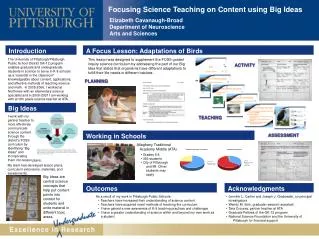
Elizabeth Cavanaugh-BroadDepartment of NeuroscienceArts and Sciences Focusing Science Teaching on Content using Big Ideas Introduction A Focus Lesson: Adaptations of Birds The University of Pittsburgh/Pittsburgh Public School District GK-12 program enables graduate and undergraduate students in science to serve in K-8 schools as a “scientist in the classroom” knowledgeable about content, applications, and effective methods of teaching science and math. In 2005-2006, I worked at Northview with an elementary science specialist and in 2006-2007 I am working with an 8th grade science teacher at ATA. This lesson was designed to supplement the FOSS guided inquiry science curriculum by addressing the part of our Big Idea that states that organisms have different adaptations to fulfill their life needs in different habitats. ACTIVITY PLANNING Big Ideas I work with my partner teacher to more effectively communicate science content through the district’s FOSS curriculum by identifying “Big Ideas" and incorporating them into lesson TEACHING Working in Schools ASSESSMENT Allegheny Traditional Academy Middle (ATA) • Grades 6-8 • 303 students • City of Pittsburgh and Mt. Oliver students may apply Reprinted, with permission, from: Tools for Change: Curriculum Enactment Through Teacher-Scientist Partnerships, Wendy M. Sink, Jennifer L. Cartier, Joseph J. Grabowski; paper presented at the annual conference of the Association for Science Teacher Educators Clearwater, Florida, January 5, 2007. plans. My team has developed lesson plans, curriculum extensions, materials, and assessments. Big Ideas are central science concepts that help put content points into context for students and unite material in different topic areas. Outcomes Acknowledgments • As a result of my work in Pittsburgh Public Schools: • Teachers have increased their understanding of science content • Teachers have acquired novel methods of teaching the curriculum • I have gained a new awareness of K-8 teaching practices and challenges • I have a greater understanding of science within and beyond my own work as a student. • Jennifer L. Cartier and Joseph J. Grabowski, co-principal investigators • Wendy M. Sink, graduate research assistant • Tara Crousey, partner teacher at ATA • Graduate Fellows of the GK-12 program • National Science Foundation and the University of Pittsburgh for financial support