Understanding Contrast and Themes in Edward Thomas's Poetry
70 likes | 185 Vues
This lesson focuses on developing an understanding of Edward Thomas's poem, exploring the use of contrast in poetry, particularly between nature and war. We will analyze the vocabulary related to agriculture and natural imagery while discussing the poem's overarching message about life during the war and its impact on rural Britain. Through group discussions, students will reflect on the significance of events mentioned in the poem, its rhyme scheme, and the techniques used to convey the poignant themes of conflict and continuity in life.


Understanding Contrast and Themes in Edward Thomas's Poetry
E N D
Presentation Transcript
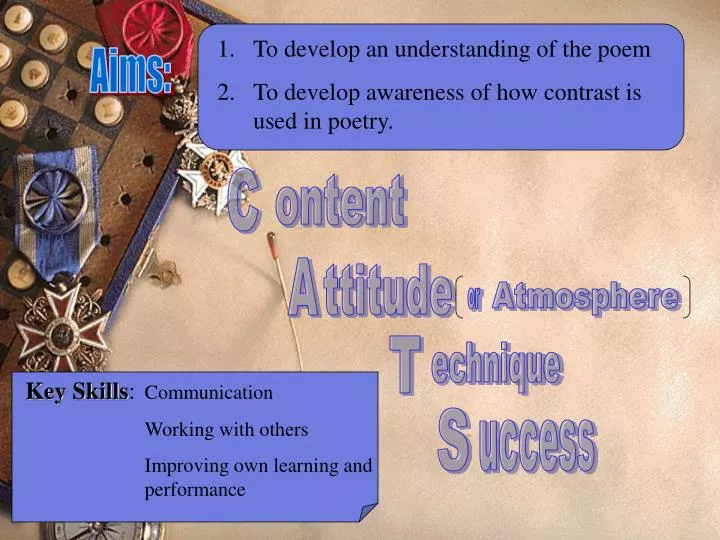
To develop an understanding of the poem • To develop awareness of how contrast is used in poetry. Aims: C ontent A ttitude Atmosphere or T echnique Key Skills: Communication Working with others Improving own learning and performance S uccess
Biography • Born: 1878, London, Welsh parents • Oxford University • Journalist • Enlisted: 1914 • Died: 1917 – Arras battlefield Edward Thomas
As the Team’s Head Brass This refers to the horse brasses on a team of horses, pulling a plough.
ontent C Match up these words to their meanings: Fallow Charlock Furrow Clods Bough • Branch • lumps of earth • a field left uncultivated for a year • a yellow flowered weed • a narrow trench left by a plough Briefly explain what happens in this poem.
A ttitude • Highlight all the words with agricultural/natural associations. • Highlight all the parts of the poem that refer to the war. • Group work • Discuss whether or not this is a war poem.
S uccess • What do you think is the message of this poem? • Life goes on during the war • Events in France effect what happens in rural Britain • The catastrophic events of the war are reflected in nature. • How effectively does this poem convey this?
T echnique • In the men’s conversation we find out that two important events have occurred on the same night. • What are they? • What is the significance of this? What is the rhyme scheme of this poem? Why do you think the poet used this scheme? Clue: it’s a conversation