Download
1 / 17
170 likes | 278 Vues
This study explores the assembly and function of multiprotein systems within membrane structures, with a focus on the photosynthetic unit of purple bacteria and the purple membrane of halobacteria. Utilizing advanced molecular dynamics simulations, we analyze the organization, hydration, and thermodynamics of these systems, particularly the bacteriorhodopsin (bR) monomer. Insights into protein-lipid interactions, molecular electronics applications, and the role of hydration in protein function are discussed, providing a comprehensive understanding of these crucial biological architectures.

E N D
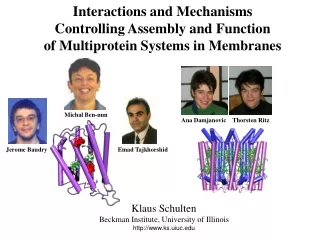
Interactions and MechanismsControlling Assembly and Functionof Multiprotein Systems in Membranes Michal Ben-nun Ana Damjanovic Thorsten Ritz Jerome Baudry Emad Tajkhorshid Klaus Schulten Beckman Institute, University of Illinois http://www.ks.uiuc.edu
Organization of the Photosynthetic Unit of Purple Bacteria hn H+ V assembly proteins function molecular electronics
Organization of the Purple Membrane of Halobacteria hn H+ V assembly function protein molecular electronics
lipids bR monomer 2-D crystalline organization of the purple membrane ~ 75 Å Top and side views of the purple membrane
Structure of the hexagonal unit cell-1 top view lateral view • green,blue,red : bR monomers (Essen et al., P.N.A.S., 1998) • grey : PGP extra-trimer lipids. (Pebay-Peyroula et al., Structure, 1999) • purple : squalene (Luecke et al., J. Mol. Biol., 1999) • orange : intra-trimer glycolipids (Essen et al., P.N.A.S., 1998) • yellow : intra-trimer Phosphatidyl Glycerol Phosphate lipid
Asymmetry of the Purple Membrane Extracellular intracellular Blue : basic residues Red: acidic residues Green: polar residues White : apolar residues Grey : lipids
Structure of the hexagonal unit cell-2 Hydration of the unit cell • Internal hydration (Luecke et al., J. Mol. Biol., 1999) • External hydration : molecular dynamics
Thermodynamics of the Purple Membrane PM thickness NpT simulation: constant temperature, variable volume In-plane dimensions Reduction of PM thickness during NpT simulation
Distribution of external water after MD Equilibration of PM: rearrangement of water molecules Before MD After MD water Nb of atoms protein “c” dimension perpendicular to the membrane Top view of PM: Water molecules penetrate the PM but not the protein, stop at Arg82 & Asp96
Asp96 Arg82 Crystallographic water molecules Crystallographic water molecules in initial structure After 1 ns MD: Crystallographic water molecules diffuse outside PM, except molecules located within the Arg82 Asp96 channel (in white)
Asp96 retinal Arg82 Structure of the hexagonal unit cell-3 External hydration (larger orange spheres) penetrates into bR up to the Arg82 & Asp96 levels
Bacteriorhodopsin Monomer retinal • Simplest ion pump in biology • Best characterized membrane protein (GPCRs) • Simplest photosynthetic center • Several molecular electronics applications
Molecular Dynamics Simulations of the Purple Membrane • Molecular dynamics simulations with NAMD2 • ~23700 atoms per unit cell • Hexagonal unit cell • Periodic boundary conditions in 3D (multilayers) • NpT (constant pressure) simulations • Particle Mesh Ewald (no electrostatic cutoff) • ~2 weeks/ns on 4 Alpha AXP21264-500Mhz procs.
Reaction coordinates for the conical intersection: Torsion around C13=C14 and h- vector Torsion and h- vector Conical intersection S0 and S1 surfaces as a function of torsionalangle and h- vector
Structures at the minima of S0 and S1 surfaces and structure of the conical intersection minima of S0 minima of S1 • Search for conical intersection started from both optimized geometries and converged to same structure • Bond in Å, angles in degrees, (in brackets: values at the conical intersection). • Minima at S1 nearly coincides with lowest point of conical intersection • SA-CASSCF(10,10) geometry optimized on ground and excited states.
Quantum Dynamics on Multiple Electronic States Description of photoprocess of retinal in protein Full Multiple Spawning (Todd Martinez) Final structure of a single quantum dynamics trajectory • Other important quantum effects: • zero point energy • Specific heat • Energy relaxation • Ben-Nun et al., Faraday Discussion, 110, 447-462 (1998)
Does water rearrangement lead to a proton switch in bR? Asp96 13-cis retinal after photo-isomerization N Asp85 Asp212 Arg82 two scenarios N N Asp85 H+ Asp85 Arg82 Arg82 Water coming from cytoplasmic channel, Arg82 “down” Water coming from extracellular channel, Arg82 “up”