Electron Emission from Vertically Oriented Few-Layer Graphene
160 likes | 487 Vues
Electron Emission from Vertically Oriented Few-Layer Graphene. Proposed by: Kevin McMullen April 27, 2009. Overview. Applications of field emission Theory of electron emission Successes in CNTs Proposed work with graphene Objectives of proposed work. Applications.


Electron Emission from Vertically Oriented Few-Layer Graphene
E N D
Presentation Transcript
Electron Emission from Vertically Oriented Few-Layer Graphene Proposed by: Kevin McMullen April 27, 2009
Overview • Applications of field emission • Theory of electron emission • Successes in CNTs • Proposed work with graphene • Objectives of proposed work K. McMullen
Applications • Direct conversion from heat or solar to electrical power • Direct refrigeration • Scanning Electron Microscopy – electron guns • Flat panel displays K. McMullen
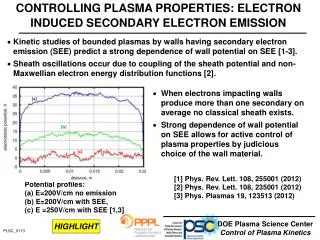
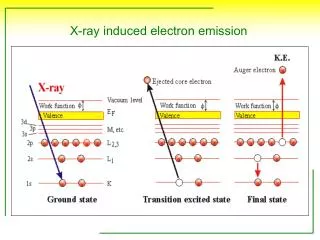
Types of Electron Emission • Field Emission • Potential barrier is distorted by electric field allowing electrons to tunnel out • Thermionic Emission • Electrons thermally excited over potential barrier • Photoemission • Photon excites electron over potential barrier (Diagram from Tyler Westover Thesis) K. McMullen
CNTs as Emission Sources • CNTs have been well researched as sources • Sharp tips lead to local field enhancement • Possible to emit up to 0.2 mA per MWCNT • Low electron emission field threshold K. McMullen
Intercalation • SWCNT with 1.4nm diameter, in 20nm bundles • Pristine sample: φ=4.8eVIntercalated sample: φ=2.4eV • Other alkali metals (K, Na) show similar improvements Potassium intercalation from another study K. McMullen
Local Field Enhancement • The field is distorted locally by a ‘sharp’ feature • Radii below 50nm show appreciable enhancement To attain 10A/cm2 need field of: 1.08V/μm for 5nm feature 614V/ μm for planar surface K. McMullen
Enhancement at Open Ends • Observed current 1 million times greater after heating open tip to 1500° • Theorized that a carbon “atomic wire” was being formed at tip by E-field • Unraveling can continue and destroy the tube (Science, 1995) Geometrically sharpest possible emitter K. McMullen
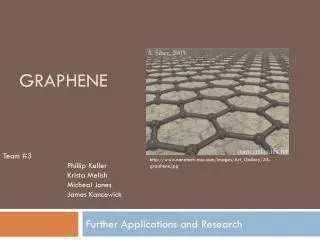
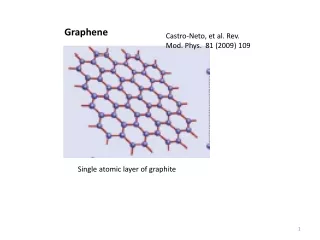
Proposed Work on Graphene • Few Layer Graphene (FLG) has structure similar to MWCNT • Thickness of FLG is a few nanometers→sharp in 2-D • Intercalation should be possible • ‘Unraveling’ should also be observable K. McMullen
FLG Growth • 4-6 layer graphene synthesized on any substrate without catalyst • Number of layers characterized by TEM • Repeatable process K. McMullen
Experimental Apparatus • Equipment available: • Test configurations for field, thermionic and photo emission • Vacuum background <10-7 Torr • Phobios Hemispherical Energy Analyzer (resolution ~0.04 eV) • PECVD for graphene growth Schematic of a PECVD (M. Meyyappan et al., Plasma Sources Sci. Tech. 2003) K. McMullen
Outcomes of Proposed Work • Determine graphene emission current and its dependency on number of layers • Measure effects of intercalates on work function • Identify ‘unraveling’ of FLG • Measure work function changes caused by edge chemistry K. McMullen