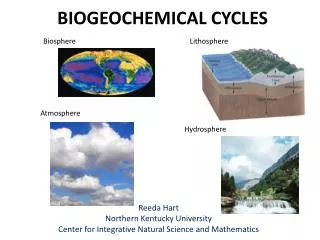
Exploring Biogeochemical Cycles: The Water Cycle and Its Unique Challenges
260 likes | 373 Vues
This lecture delves into the water cycle, emphasizing its unique properties and the critical role of snowpack and glaciers as mountain 'water towers.' We'll discuss the impacts of climate change on various watersheds, including case studies from the Chehalis River flood, the Skagit Watershed's declining snowpack, and the environmental challenges faced by urban watersheds. The presentation will also cover the relationships between water quantity, quality, and seasonal distribution, as well as practical alternatives for managing stormwater in urban areas.


Exploring Biogeochemical Cycles: The Water Cycle and Its Unique Challenges
E N D
Presentation Transcript
Biogeochemical Cycles - 2 Class Lecture Goals Focus on the Water Cycle Unique aspects of water Three case studies Chehalis River Flood Skagit Watershed: Loss of snow pack and glaciers Urban Watersheds
Environmental Issues • Seattle Times - PI Sunday: Gravel pits as a a non-renewal resource • National Geographic Magazine - January (Recyling)
Reading Science 2004
10 Answer Now! The concern about loss of snow pack is because snow water makes up __% of stream water in the west • 25 • 33 • 75 • 100
Take-home messages Premise: Glaciers, permanent snow fields and snow pack are the ‘water towers’ of the mountains • • Decreased snow packs • • Biggest drops, lower elevations • • Biggest drops, PNW • • Snow is melting earlier in the spring • • Disagreement: Mote vs. Taylor • • Index year (1950) • • Role of PDOs vs. climate change • • Uncertainty • • Shifts in timing of runoff • • Impacts on summer water
Water Cycle Image/Text/Data from the University of Illinois WW2010 Project http://ga.water.usgs.gov/edu/watercyclesummary.html
Water Cycle Details • Properties of water • Nature of stream flow (critical roles) • Three cases • Chehalis River flood • Skagit Watershed • Urban watershed
Quantities of Water • Changes in Ice • If all glaciers & icecaps melted today the seas would rise about 230 feet (70 meters). • During the last ice age, the sea level was about 400 feet (122 meters) lower than today. • During the last warm spell, 125,000 years ago, the seas were about 18 feet (5.5 meters) higher than today.
O O O O O O O H H H H H H H H H H H H H H - - - - - - - - - - - - + + + + + + + + + + + + Unique Properties of Water • • Small molecule • Three states: liquid, solid, gas • Liquid from 0 - 100oC • Takes lots of energy to change state or change temperature • Transparent • Solvent • Solid vs. liquid • Movement in plants
Understand the behavior of a watershed http://wa.water.usgs.gov/realtime/rt_latest_map.html
Agriculture Urban Forest-Ag Forest Behavior of Water in a Watershed • Use of a hydrograph (stream gauge) Discharge Rain 0 12 Time
Behavior of Water in a Watershed • Westside, little or no snow • Westside, lots of snow
Behavior of Water in a Watershed • Eastside, snow, NE WA • Urban - suburban stream
18 16 14 1. Chehalis River Flood
Effects of trees vs. no trees • Assume 100” • Amount & type of precipitation (ppt) - no difference. • Trees intercept ppt (5 - 15%) • Forest soil is drier: Trees transpire (20%) • Snow stays colder under forest • Snow accumulates more slowly under forest • Roots provide strength • Roads are bad
2. Skagit Watershed • Third largest on the west coast of US • 3100 mile2 (about 1/6th in Canada) • Major agriculture • Major salmon • National Park • Seattle City Light
1928 2000 South Cascade Glacier from ~1850 (see blue overlay) to 2005 (see above photo).
1890 1928 2001 2005 Glacier Volume (km3) Year South Cascade Glacier Data Volume of South Cascade Glacier from ~1850 to 2005. Data for 1850 is an estimate.
Alternatives • Storage system • Green roofs • Example from Sea-Streets
9 Answer Now! In your view, which alternative seems the most viable • Using cisterns (tanks) to collect runoff • Requiring green roofs • Using the S.E.A.-Street model
Major (Climate) Change Issues Premise: Clean, fresh water is a rare resource • Quantity of water • Seasonal and spatial distribution • Form of water/rain on snow • Cloud and fog formation and spatial distribution • Uses of water • Loss of forests and vegetation • Increases in impervious surfaces
Summary: Water Cycle • Water cycle: Quantity, Quality, Form, & Timing • Properties of water • Watershed • Climate, geographic location and water • Three cases • Chehalis Flood • Skagit Watershed • Urban Watersheds