Identifying High-Risk Caregiver Groups for Effective Depression Prevention Among Dementia Caregivers
This study aimed to identify target groups for depression prevention among caregivers of dementia patients. Conducted over 18 months with 725 participants initially free of depression, we assessed the incidence of depression through follow-up measurements. Our analysis revealed that 24.8% developed depression. By focusing on the strongest risk indicators, we established efficient criteria for selecting high-risk groups for targeted interventions, contributing to cost-effective prevention strategies for caregiver depression.

Identifying High-Risk Caregiver Groups for Effective Depression Prevention Among Dementia Caregivers
E N D
Presentation Transcript
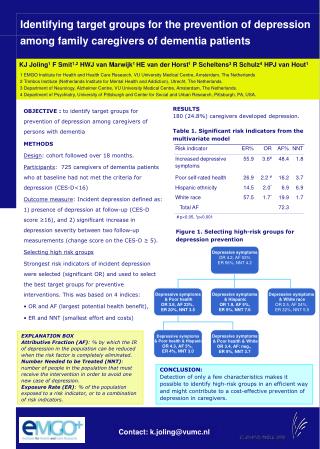
OBJECTIVE : to identify target groups for prevention of depression among caregivers of persons with dementia METHODS Design: cohort followed over 18 months. Participants: 725 caregivers of dementia patients who at baseline had not met the criteria for depression (CES-D<16) Outcome measure: Incident depression defined as: 1) presence of depression at follow-up (CES-D score ≥16), and 2) significant increase in depression severity between two follow-up measurements (change score on the CES-D ≥ 5). Selecting high risk groups Strongest risk indicators of incident depression were selected (significant OR) and used to select the best target groups for preventive interventions. This was based on 4 indices: OR and AF (largest potential health benefit), ER and NNT (smallest effort and costs) Identifying target groups for the prevention of depression among family caregivers of dementia patients KJ Joling1 F Smit1,2 HWJ van Marwijk1 HE van der Horst1 P Scheltens3 R Schulz4 HPJ van Hout1 1 EMGO Institute for Health and Health Care Research, VU University Medical Centre, Amsterdam, The Netherlands 2 Trimbos Institute (Netherlands Institute for Mental Health and Addiction), Utrecht, The Netherlands. 3 Department of Neurology, Alzheimer Centre, VU University Medical Centre, Amsterdam, The Netherlands. 4 Department of Psychiatry, University of Pittsburgh and Center for Social and Urban Research, Pittsburgh, PA, USA. RESULTS 180 (24.8%) caregivers developed depression. Table 1. Significant risk indicators from the multivariate model # p<0.05, *p<0.001 Figure 1. Selecting high-risk groups for depression prevention EXPLANATION BOX Attributive Fraction (AF): % by which the IR of depression in the population can be reduced when the risk factor is completely eliminated. Number Needed to be Treated (NNT): number of people in the population that must receive the intervention in order to avoid one new case of depression. Exposure Rate (ER): % of the population exposed to a risk indicator, or to a combination of risk indicators. CONCLUSION: Detection of only a few characteristics makes it possible to identify high-risk groups in an efficient way and might contribute to a cost-effective prevention of depression in caregivers. Contact: k.joling@vumc.nl