Download
1 / 1
10 likes | 124 Vues
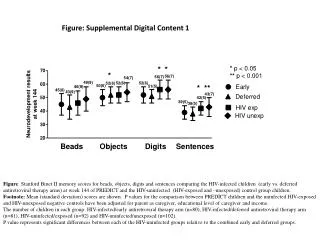
This figure presents memory scores from the Stanford-Binet II test assessing beads, objects, digits, and sentences. The comparison is made between HIV-infected children receiving early versus deferred antiretroviral therapy at week 144 of the PREDICT study, alongside a control group of HIV-uninfected children (both exposed and unexposed). Mean scores and standard deviations are indicated, with P-values adjusted for various demographic factors like caregiver education and income. Results reveal significant differences illustrating the impact of therapy timing on memory development in affected children.

E N D
Figure: Supplemental Digital Content 1 Figure: Stanford Binet II memory scores for beads, objects, digits and sentences comparing the HIV-infected children (early vs. deferred antiretroviral therapy arms) at week 144 of PREDICT and the HIV-uninfected (HIV-exposed and –unexposed) control group children. Footnote: Mean (standard deviation) scores are shown. P values for the comparison between PREDICT children and the uninfected HIV-exposed and HIV-unexposed negative controls have been adjusted for parent as caregiver, educational level of caregiver and income. The number of children in each group: HIV-infected/early antiretroviral therapy arm (n=80), HIV-infected/deferred antiretroviral therapy arm (n=81), HIV-uninfected/exposed (n=92) and HIV-uninfected/unexposed (n=102). P value represents significant differences between each of the HIV-uninfected groups relative to the combined early and deferred groups.