Understanding Naming and Formulas of Ionic and Molecular Compounds
This guide covers the systematic naming conventions and formula writing for ionic and molecular compounds. It details binary ionic compounds, emphasizing the order of cation and anion, the naming rules based on ion charge, and the inclusion of Roman numerals for metals with multiple charges. Additionally, it explains polyatomic ions and their role in forming compounds. For molecular compounds, the guide outlines naming based on metallic character, the use of prefixes for atom quantity, and guidelines for writing accurate molecular formulas.

Understanding Naming and Formulas of Ionic and Molecular Compounds
E N D
Presentation Transcript
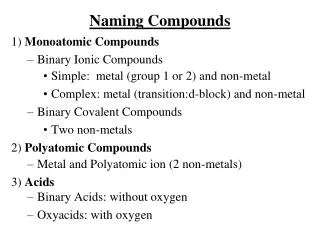
I. Describing Ionic Compounds A. Binary Ionic Compounds—made of two elements 1. cation (+) before anion (-) 2. cation is the same as the element name 3. anion uses part of the name of the nonmetal with the suffix –ide
B. Metals with multiple ions 1. Many transition metals form more than one type of ion 2. When a metal forms more than one ion, the name contains a Roman numeral to indicate charge
C. Polyatomic ions--A covalently bonded group of atoms that has a positive or negative charge and acts as a unit.
D. Writing formulas for ionic compounds 1. Write the cation symbol first 2. Use subscripts so that the total charge is 0
The formula for an ionic compound is CaBr2. What is the name of the compound? • What are the formulas for the ionic compounds named sodium iodide and magnesium iodide? • Write the formula for iron (III) phosphide. • Chromate is a polyatomic ion with a charge of negative 2. It contains chromium and oxygen in a one-to-four ratio. What is it’s formula?
II. Describing Molecular Compounds A. Naming molecular compounds 1. Write the most metallic element first (farther to the left on the periodic table) 2. If they are in the same group, the more metallic is closer to the bottom. 3. The name of the 2nd is changed to end in -ide 4. Use the correct prefix in front of the name to indicate how many atoms of that element 5. Exception: mono- is not usually used for the first element
B. Writing molecular formulas 1. Write the symbols in the order they appear in the name. 2. The prefix indicates the subscript to use.
Name the molecular compound P2O5 • Name the molecular compound CO • What is the formula for the diphosphorustetrafluoride?