Download
1 / 45
450 likes | 565 Vues
This study compares the effectiveness of non-elastic and elastic tapes in restricting talocrural-subtalar joint movements to prevent ankle sprains. The research investigates how different tape materials impact joint stability and motion control. Results indicate that non-elastic tape may provide better restriction for inversion tilt. Elastic tapes are gaining favor but may not be as effective in limiting certain joint movements. These findings contribute to understanding the optimal tape material for ankle sprain prevention strategies.

E N D
Comparative Effects of Tape Material Characteristics on Talocrural-Subtalar Joint Motions Meredith A. Atwood, ATC, LAT Graduate Athletic Training Program University of Tennessee-Chattanooga
Objective • Determine if elastic tape can restrain talocural-subtalar joint displacement or angular motion as effectively as standard non-elastic tape
Background • 23,000 ankle sprains occur per day in the U.S. (Hartel, 2002) • That’s 16 ankle sprains per minute • Ankle sprains take one week to six weeks to heal (Hockenburg, 2001)
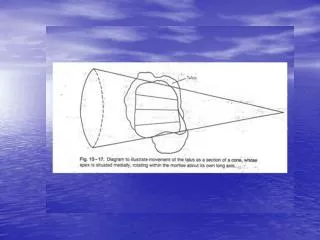
Anatomy of the Ankle • Talocrural joint • Subtalar joint • Talocrural-subtalar joint complex
Anterior translation Posterior translation Movement of the Talocrural-Subtalar Joint Complex
Movement of the Talocrural-Subtalar Joint Complex • Inversion tilt • Eversion tilt
Ankle Taping • Non-elastic tape • Most widely used • Most widely debated(Alt, 1999; Cordova, 2002; Myburgh, 1984; Rarick, 1962) • Elastic Tape • gaining favor(Firer, 1990; Passerallo, 1994) • (
Tape • Non-elastic • Standard white athletic tape • Cloth • Zinc Oxide adheres to skin
Tape • Elastic tape • Cohesive adheres to itself, but not to skin • Adhesive adheres to skin - (Andover, 2002; Leuko, 2005)
Protection • Protect ligaments by decreases excessive motion(Callaghan, 1997; Greene, 1990; Rarick, 1962; Ricard, 2000) • Provide mechanical stability(Karlsson, 1993; Laughman, 1980) • Despite loosening does provides support(Alt, 1999; Fumich, 1981; Greene, 1990; Larsen, 1984; Mayburgh, 1984; Ricard, 2000; Rovere, 1988)
Research Hypothesis • Non-elastic tape will restrict inversion tilt more effectively than elastic tape. • Non-elastic tape will restrict anterior translation more effectively than elastic tape
Tape Conditions • Four conditions • non-elastic taped condition • cohesive elastic taped condition • adhesive elastic taped condition • Untaped condition
Subjects • UTC IRB approved • 15 subjects from UTC student population • mean age: 25 + 3.6 years • mean height: 173 + 11.6cm • mean weight: 77 + 11.4kg • Participants received all conditions
Instrument • Ankle Arthrometer (Kovaleski, 2002; Kovaleski, 1999)
Measurements • Anteroposterior translation (mm) • Inversion-eversion tilt (deg) • Pre-exercise & post-exercise
Exercise Program • 1 - Half mile jog • 2 - 300 yard shuttle runs • 4 - figure-of-eight patterns ran in each direction • 2 - one legged hop pattern for each leg
Exercise Program Figure-of-eight run One legged hop pattern
Statistical Analysis • Separate Repeated Measures ANOVAs • inversion tilt • anterior translation • 2x3 (trial x condition ) • significance • main effect • Bonferroni adjustment: alpha level = .025
Statistical Analysis • Separate Repeated Measures ANOVAs • inversion tilt • anterior translation • post-exercise • Significant difference • Pairwise comparison
Repeated Measures ANOVA Trial x Condition • 2x3 (trial x condition) repeated measures ANOVA was significant for inversion tilt • F 2,28 = 8.24, p = .002 • 1- = .96
Main Effects for Inversion Tilt • Significant difference b/t trials • F 1,14 = 40.67, p = .001 • 1- = 1.00
Main Effects for Inversion Tilt • Significant difference b/t conditions • F 2, 28 = 6.08, p = .006 • 1- = .85
Repeated Measures ANOVA Trial x Condition • Repeated measures trial x condition was not significant for anterior translation • (F 2,28 = .449), p = .643
Main Effects for Anterior Translation • There was not a significant difference b/t trials • F 1, 14 = .131, p = .722 • There was not a significant difference b/t conditions • F2, 28 = .449, p = .643
Repeated Measures ANOVA by Condition Inversion Tilt • Significant difference b/t mean displacement for post-exercise inversion tilt • F 3,42 = 87.26, p = .001 • 1- = .86
Repeated Measures ANOVA by Condition Anterior Translation • There was not a significant difference b/t the mean displacement for post-exercise anterior translation • F 3,42 = .062, p = .980
Pairwise Comparison of Anterior Translation Post-exercise • Taped Comparison p-value • Non-elastic x Cohesive .871 • Non-elastic x Adhesive .810 • Non-elastic x Untaped .920 • Cohesive x Adhesive .933 • Cohesive x Untaped .768 • Adhesive x Untaped .704
Discussion • Results demonstrate that: • non-elastic tape restricts inversion tilt more effectively than elastic tape • anterior translation not affected by tape material
Increase in Displacement for Inversion Tilt • All tape conditions showed an in displacement • Non-elastic had smallest in displacement • Adhesive elastic has greatest in displacement • Similar to previous research (Alt, 1999; Fumich, 1981; Greene, 1990; Larsen, 1984; Mayburgh, 1984)
Anterior Translation • Anterior translation • no significant difference • taped conditions equivalent to untaped condition • tape configuration is more important (Wilkerson,2005)
Comparison of Tape Procedures Post-Exercise WILKERSON ET AL CURRENT STUDY • Inversion Tilt • Untaped 32.66 + 9.1 Untaped 3.21 + 9.2 • Standard 10.20 + 2.4 Non-elastic 12.93 + 3.0 • Modified (STS) 7.19 + 1.8 Cohesive Elastic 16.27 + 4.8 • Adhesive Elastic 15.23 + 2.5 • Anterior Translation • Untaped 9.25 + 2.3 Untaped 8.45 + 1.9 • Standard 6.19 + 1.6 Non-elastic 8.52 + 2.0 • Modified (STS) 4.92 + 1.3 Cohesive Elastic 8.65 + 1.9 • Adhesive Elastic 8.71 + 2.4
Conclusion • Elastic tapes do not restrict inversion as effectively as non-elastic tape • Tape material is not a factor in preventing anterior translation
Future Research • Little done on injured ankles • More research on tape configuration for anterior translation • More research using ankle arthrometer for objective measurements
My Appreciation • Dr. Wilkerson • Dr. Colston • Dr. Whittle • Dr. Kovaleski & Dr. Hollis • Phil Heywood
Questions? Thank You for Your Time. Graduate Athletic Training Program