Download
1 / 12
120 likes | 235 Vues
This presentation, delivered on February 10th, 2010, covers the Universal Serial Bus (USB) technology—its invention, workings, and various applications. It explains the history of USB's development by major tech companies in 1996 and contrasts it with previous connection ports like RS-232 and SCSI. The presentation elaborates on the communication protocol, hardware connections, signal transmission, and different modes of data transfer including control, interrupt, isochrone, and bulk transmission. It emphasizes USB's role in standardizing connections and its significance in modern technology.

E N D
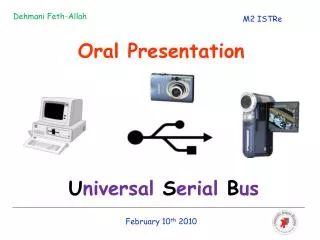
Oral Presentation Universal Serial Bus February 10th 2010
Summary I. Presentation (Where, When, Why…) USB PRESENTATION II. How does it work ? HOW DOES IT WORK ? III. Applications APPLICATIONS February 10th 2010
Presentation Generalities: Invented in 1996 by Microsoft, IBM, Intel, Compaq, Digital, NEC et Northern Telecom (USB 1.0) USB PRESENTATION Before invention of USB : Differents connexion port and protocol communication like RS-232, parallel, PS-2 or SCSI. HOW DOES IT WORK ? APPLICATIONS Purpose : Standardization of serial communication between a host and a device with a unique connexion and a unique communication protocol February 10th 2010
Presentation Hardware connexions : USB PRESENTATION HOW DOES IT WORK ? APPLICATIONS HOST DEVICE February 10th 2010
How does it work ? Signal connexions : USB PRESENTATION HOW DOES IT WORK ? APPLICATIONS 4. GND 1. VDD 2 & 3. DATA (D+ & D-) February 10th 2010
How does it work ? USB Bus description NRZI diferential encryption between D+ and D- USB PRESENTATION LSB first transmit (Little Endian). HOW DOES IT WORK ? Speed APPLICATIONS February 10th 2010
How does it work ? Communication protocol : « Host – Slave » system USB PRESENTATION Frame transmission (Token et Data) HOW DOES IT WORK ? Token frame APPLICATIONS DATA frame February 10th 2010
How does it work ? Transmission : Control : for command operation (enumeration, state of the device…) USB PRESENTATION Interrupt : for device with garanted time delay (mouse, keyboard…) HOW DOES IT WORK ? Isochrone : for device with garanted bit rate (garanted bandwidth : ex : printer, camera…) APPLICATIONS Bulk: for big data transmissions (take maximum bandwidth as possible) February 10th 2010
How does it work ? Enumeration: Identification process of the device by the host USB PRESENTATION CONNEXION HOW DOES IT WORK ? SPEED DETECTION APPLICATIONS DEVICE IDENTIFICATION High level in D+ ou D- Send descriptors February 10th 2010
Applications DATA TRANSFER OR CONTROL COMMAND USB PRESENTATION BUS ENERGY (only hardware, 500mA max) USB HOW DOES IT WORK ? REAL TIME APPLICATIONS APPLICATIONS February 10th 2010
Conclusion Today, USB is one of the most serial protocole used FireWire (Apple) is the alternative of USB (3 200 Mbits/s) To sell USB device, you need to buy a Vendor ID (≈ 2000 $ US / year) February 10th 2010