Download
1 / 37
370 likes | 487 Vues
This study explores the propagation of magnetic helicity generated within the Sun. It reveals significant hemispheric asymmetry in the helicity of the coronal magnetic field, indicating variations between the northern and southern solar hemispheres. We discuss observed trends in photospheric twist, implications for the structure of convective zone flux tubes, and how these patterns couple to the coronal field. By integrating observational evidence, including emerging active regions, we provide a detailed analysis of the dynamics of magnetic helicity and its conservation in solar phenomena.

E N D
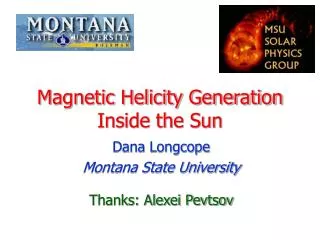
Magnetic Helicity Generation Inside the Sun Dana Longcope Montana State University Thanks: Alexei Pevtsov
Propagation from Magnetic Helicity Generation Inside the Sun Observations show a clear hemispheric asymmetry in the helicity of the coronal magnetic field: HR < 0 in the North Q: Can we therefore conclude that field below the solar surface, and in the dynamo, has this same asymmetry? Answer: No
Magnetic Helicity Propagation from Inside the Sun • Observed trends in photospheric twist • Implications for state of CZ flux tubes • Coupling of twist to coronal field • Observational evidence in emerging AR
Trend in photospheric twist Trend: abest< 0 in North abest> 0 in South Correlation: abest w/ latitude > 99.9999% 466 ARs from Longcope & Pevtsov 2003
Fluctuations in twist Large latitude-indep’t scatter a created by turbulence Linear trend removed (from Longcope, Fisher & Pevtsov 1998)
The origin of flux Bipolar active region formed by emergence of FLUX TUBE from below photosphere (from Cauzzi et al. 1996)
Twist in flux tubes s s Field lines twist about axis at a rate q(s,t) “=“ dq/ds Plasma spins about axis at rate w(s,t) “=“ dq/dt Axis of tube: x(s) satisfies thin flux tube equations (Spruit 1981)
Dynamics of twist (from Longcope & Klapper 1997) s Angular momentum: Unbalanced magnetic torque q(s) w(s)
Dynamics of twist (from Longcope & Klapper 1997) Field line Kinematics s w(s) Differential spinning q(s)
Dynamics of twist (from Longcope & Klapper 1997) Field line Kinematics s w(s) Differential spinning q(s)
Dynamics of twist • Torsional Alven waves
Dynamics of twist (from Longcope & Klapper 1997) Field line Kinematics s vs(s) Axial stretching q(s)
Dynamics of twist (from Longcope & Klapper 1997) Field line Kinematics s vs(s) Axial stretching q(s)
Dynamics of twist Out-of-plane motion of axis S(s) indep. of q or w
Source of Twist Helicity Conservation • Increasing LH • writhe (dWr/dt <0 ) • Increasing RH twist (dTw/dt > 0)
S=a J J B B RH a-effect S-effect • Applies to mean fields • Creates Helicity* • RH eddies LH field • Applies to flux tubes • Creates Twist • RH eddies RHtwist * in the mean field
Manifestation of S-effect • Simulation of • rising flux • tubes • Large scatter • Da • Latitude-indep. • Da ( Longcope, Fisher & Pevtsov 1998 )
Coupling flux tube to corona corona: b << 1 (force-free field) I=0 photosphere I=0 surface currents CZ: b >> 1 (thin flux tube)
Coupling flux tube to corona q(s) Radial shunting Storques= 0 (Longcope & Weslch 2000)
Coupling flux tube to corona Low inertia Storques= 0 Current matches across interface q(s) Twist at end of FT Coronal “twist” (Longcope & Weslch 2000)
Application to Emerging AR (Longcope & Welsch 2000) Model Assumptions Model Assumptions • Initial flux tube: uniformly twisted:q(s)=a/2 • Poles separating:d(t) = d0 + v (t-t0) Twist propagates into corona a(t) d/vA ~ 1 day
Application to Emerging AR (Pevtsov, Maleev & Longcope 2003) Model Assumptions • Initial flux tube: uniformly twisted: q(s)=a/2 • Poles separating: d(t) = d0 + v (t-t0) • Uniform Alfven speed in tube: vA= nv • Coronal helicity:H = ad F2 Solution
Observational Evidence (Pevtsov, Maleev & Longcope 2003) • Study 6 ARs during emergence • Findd(t) • a(t) 8/19 12:47 8/19 20:47 8/20 4:47 8/20 20:47 8/21 4:47 8/20 12:47 AR9139 SOHO MDI 2000-8-19 d
Observational Evidence (Pevtsov, Maleev & Longcope 2003) Fit Model to Data v=264 m/s a = 2 10-8 m-1 vA = 158 m/s
Observational Evidence (Pevtsov, Maleev & Longcope 2003) AR8582 AR8817
Implications of model • Twistexists before emergence • (i.e. rising tube is twisted) • Tube Twist propagates into corona • Coronal Helicity I
Implications of model • Twist Helicity q(s) F2 ~ I(s)F uniform • Twist fills in lengthening region • It DOES NOT favor wider portion Parker 1979 Longcope & Welsch 2000 • Assumes p(r)=constant • Predates Berger & Field • No BG coronal field • Assumes b>>1 b<<1 • Conserves Helicity • Includes BG coronal field
Implications of model • Tube Writhe: irrelevant to corona • Helicity dearth propagates downward
Summary • Observed: Hemispheric trend • in p-spheric twist coronal HR • Coronal HR fixed by • TWIST of anchoring tube • S-effect produces TWIST in rising FT • BUT leaves helicity unchanged • Observed: Helicity evolution in • emerging AR consistent w/ this
Dynamics of twist (from Longcope & Klapper 1997) Angular momentum: s a q(s) w(s) Changing tube radius (Michelle Kwan effect)
Coupling flux tube to corona Low-bcoronal Equilibrium: FFF High-bCZ Field: twisted Thin flux tube Interface
Possible sources of twist • Initial state of flux tube: q(s,0)
Possible sources of twist • Initial state of flux tube: q(s,0) • External flow “twirls” tube segment Creates regions of opposing twist Requires anomalous “friction” across flux tube surface
Possible sources of twist • Initial state of flux tube: q(s,0) • External flow “twirls” tube segment • Net current driven along flux tube Violates assumption of isolated flux tube Cannot be a “thin flux tube”
Axis-twist coupling Term required to conserve H = Tw + Wr Function of twist Function of axis Kinematic eq. for twist depends on axis motion
Photospheric twist w/o Helicity* • Tube crosses photosphere • Helicity is transported into • coronal field • Current in coronal field • matches twsit in flux tube • Begin w/ straight untwisted tube • (H=0) • External flows induce LH writhe • (dH/dt =0) • Coupling term SRH twist * From the emergence of a flux tube with no net helicty
Writhe from Turbulence: The S-effect Twist source Averaging over turbulence: Spectrum of kinetic helicity Compare to a-effect: Variance of twist source: