Understanding Borg-Warner Issues: TCE, Bargaining Categories, and Legal Implications
This overview focuses on the Borg-Warner case, categorizing issues into three types: Mandatory (TCE), Permissive (non-TCE), and Unlawful. It explores the necessity for parties to negotiate over TCE matters, alongside the role of the Board in determining impasses. The content also discusses the absence of M-P distinction in Canada, Section 8(d) statutory interpretation, and the friction between majority and dissenting opinions regarding bargaining practices. Understanding these concepts is crucial for legal professionals and labor negotiators.

Understanding Borg-Warner Issues: TCE, Bargaining Categories, and Legal Implications
E N D
Presentation Transcript
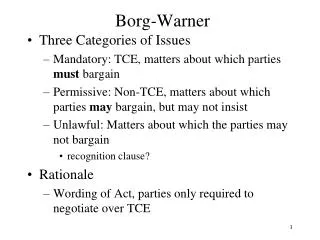
Borg-Warner • Three Categories of Issues • Mandatory: TCE, matters about which parties must bargain • Permissive: Non-TCE, matters about which parties may bargain, but may not insist • Unlawful: Matters about which the parties may not bargain • recognition clause? • Rationale • Wording of Act, parties only required to negotiate over TCE
Borg-Warner (cont.) • Role of Board is to determine if impasse involves TCE • if so, may not get involved. • If not, may get involved as matter involves a potential 8(a)(5) violation • No M-P Distinction in Canada
Statutory Interpretation, Section 8(d) • Majority • Statute requires bargaining only over TCE • May not insist on matters over which the other party is not required to bargain • Dissent • Statute requires bargaining over TCE but does not prohibit bargaining over legal non-TCE
Does it make sense to say, as does the majority, that one party may propose a provision but not “insist” on it (HNB, pp. 637-38)? Does it make sense to say, as does the dissent, that one party may “insist” on a provision about which the other party is not legally required to bargain (OHN, pp. 630-40)? Majority vs. Dissent