Chemical Change
This chapter explores the fundamental concepts of chemical changes in society, distinguishing them from physical changes. Key topics include identifying important chemical reactions, recognizing evidence of chemical changes, and understanding energy roles in reactions (endothermic vs exothermic processes). The chapter explains the Law of Conservation of Mass, highlighting how mass is conserved during reactions. Examples from everyday life, such as baking bread and photosynthesis, illustrate these principles. Engaging demonstrations and applications provide a deeper understanding of healing reactions and their significance.

Chemical Change
E N D
Presentation Transcript
Chemical Change Chapter 3 Section 3.1
Objectives • Identify important reactions in society • Recognize and identify evidence for chemical changes • Differentiate between endothermic and exothermic reactions • Describe the Law of Conservation of Mass
To Start • What is the difference between a chemical and physical change? • Chemical change- something new is created with its own unique properties • Physical change- nothing new is created (just changing states) • What are the three states?
Chemical or Physical? • Which of the following are chemical changes? Physical changes?
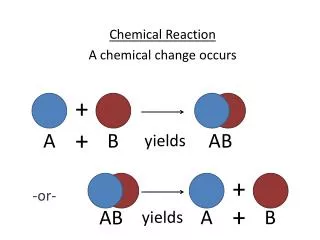
Chemical Change • Reactant + reactant product(s) • Products have different properties than reactants • Properties include: state at RT, temperature, melting point, color and density • Includes a flow of energy • IMPORTANT: drives chemical reactions • Can be fast or slow
Examples of Chemical Reactions • Batteries • Combustion Engine • Wine production • Baking bread • Photosynthesis • Cellular respiration (making energy in our bodies)
Evidence of a Chemical Change • What are ways that we know a chemical change has occurred? • Formation of a gas (bubbles) • Air bag inflation in a car • Color change • Sugar and sulfuric acid • Formation of a precipitate (change in state) • Mixing silver nitrate with sodium chloride • Flow of energy (usually detected as a change in temperature) • Combustion (lighting a match)
Formation of a Gas: Demo • What will happen when I add baking soda to vinegar in this beaker? • What will happen to the balloon placed over the top? • What gas is produced? • What other examples do we have of a formation of a gas?
Energy Changes • Two types of energy changes: • Exothermic- release of energy (*exit) • Endothermic- absorption of energy (*enter) • What change of temperature would you feel with each of these processes? • Can physical changes be exothermic and endothermic? Why or why not?
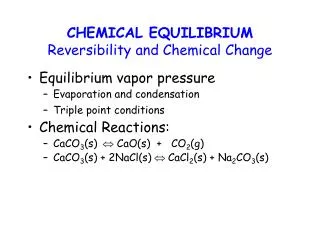
Exothermic Reactions • Release energy, usually as: • heat (flame) • light (bioluminescence) • Electricity (battery) • Important ex.: Combustion • What is combustion? • Combustion- oxygen reacts rapidly with another substance, releasing energy (burning) • 2C6H14(l) + O2(g) 12CO2(g) + 14H2O(g) + energy • (Combustion of hexane)
Endothermic Reactions • Absorb energy • Ex. Cold packs- squeeze package, breaks pack inside which keeps chemicals separate; absorb energy and whole mixture cools down • Ex. Photosynthesis • Energy + 6CO2(g) + 6H2O(l) C6H12O6(aq) + 6O2(g)
Biochemical Reactions • They may be endothermic or exothermic • They are almost always helped by enzymes (biological catalysts) • Catalysts are chemicals that speed up a reaction but are not used up by it. • Photosynthesis and Cellular Respiration
Law of Conservation of Mass • Developed by Antoine Lavoisier • Total mass of the reactants equals the total mass of the products • Using this, we can deduce that: • ** total # of atoms present before a reaction equals the total # of atoms after a reaction
Example • If I get 13 g of H2O and 15 g of NaCl from the reaction of HCl and NaOH, how much NaOH did I use, if I used 10 g of HCl? • HCl(aq) + NaOH(aq) H2O(l) + NaCl(aq) • 10g ? 13g 15g • Answer: 18 g