Understanding Chemical Changes: Reactants, Products, and Balancing Equations
This guide delves into the concept of chemical changes, highlighting the transformation of reactants into products during reactions. We explore what happens to bonds, including breaking and forming new ones, with practical examples like the rusting of iron and the decomposition of hydrogen peroxide. Learn how to represent these reactions with word and chemical equations, the role of catalysts, and the importance of balancing equations to adhere to the law of conservation of mass. Engage with activities that reinforce the process of balancing chemical equations for various reactions.

Understanding Chemical Changes: Reactants, Products, and Balancing Equations
E N D
Presentation Transcript
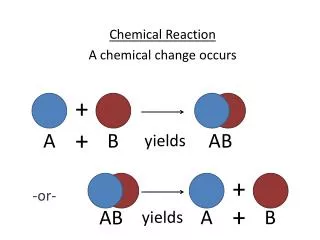
Chemical Change • Reactants Products • What happens to bonds in a chemical reaction? • Broken, form new bonds
Some examples: • Word equations • Iron + Oxygen iron (III) oxide • (word equation for the rusting of iron) • Hydrogen peroxide water + oxygen • (what happens when you pour this on an open cut? Bubbles of oxygen gas rapidly appear)
Methane + oxygen carbon dioxide + water • (major component of natural gas)
Chemical Equations • Fe(s) + O2(g) Fe2O3(s) • (rusting of iron) • Symbols are used to represent states
Chemical Equations • H2O2(aq) MnO2 H2O(l) + O2(g) • Catalyst: a substance that speeds up the rate of a reaction but that is not used up in the reaction. It is neither a reactant nor a product. It is written above the arrow in an equation because it is not part of the reaction.
Review: • Write a skeleton outline for the following chemical reaction (include appropriate symbols): • -solid sodium hydrogen carbonate reacts with hydrochloric acid to produce the aqueous sodium chloride, water, and carbon dioxide gas. • NaHCO3(s) + HCl(aq) NaCl(aq) + H2O(l) +CO2(g)
Review: • sulfur burns in oxygen to form sulfur dioxide • S(s) + O2(g) SO2(g)
Balancing Chemical Equations • Use an example of building a bicycle • 4 components: frames, wheels, handlebars, and pedals • Frame + wheel + handlebar + pedal bicycle (reactants) (product) • (why is this word equation inadequate?) • F + W + H + P FW2HP2 • (this is called an unbalanced equation, in order to balance, the amount of reactants must equal the amount of products)
Balancing Chemical Equations • coefficient: a small whole number that appears in front of a formula in a balanced chemical equation • F + 2W + H + 2P FW2HP2 • Balancing a chemical equation is necessary so that it obeys the law of conservation of mass. • balanced equation: each side of the equation has the same number of atoms of each element
Let’s try a few: • H2(g) + O2(g) H2O(l) • how would you balance this equation?
“Rules for Balancing Equations” • count the number of each atom:hydrogen is balanced but oxygen is not • put a coefficient of 2 in front of H2O, the oxygen is balanced but there are twice as many hydrogen atoms in the product as there are in the reactants • to correct this, put a coefficient of 2 in front of H2 • 2H2(g) + O2(g) 2H2O(l)
Review: • Balance the following equations: • AgNO3 + H2S Ag2S + HNO3 • 2AgNO3 + H2S Ag2S + 2HNO3 • MnO2 + HCl MnCl2 + H2O +Cl2 • MnO2 + 4HCl MnCl2 + 2H2O + Cl2
Demo: Copper(II) chloride with aluminum • Activity: “Balancing Chemical Equations”