
SlideServe
Menu
Préférences
© SlideServe · v2026

Navigating the New Normal: Challenges and Opportunities in Housing Sector Management

kaethe avatar
6 diapositives · 170 Views · Jul 11, 2014

Explore the impact of the new normal on the relationship between individuals and the state in the housing sector, including financial risks, regulatory changes, and the importance of Value for Money (VFM).
Navigating the New Normal: Challenges and Opportunities in Housing Sector Management - slide 1
01 / 6Navigating the New Normal: Challenges and Opportunities in Housing Sector Management
1 / 17

Télécharger la présentation

Navigating the New Normal: Challenges and Opportunities in Housing Sector Management
Une image / un lien ci-dessous est fourni (tel quel) pour télécharger la présentation

Politique de téléchargement : le contenu du site vous est fourni TEL QUEL pour votre information et votre usage personnel ; il ne peut être vendu, concédé sous licence ni partagé sur d’autres sites sans l’accord de son auteur.Le contenu vous est fourni TEL QUEL, pour votre information et votre usage personnel uniquement. Téléchargez la présentation en cliquant sur ce lien. Lors du téléchargement, si vous ne parvenez pas à télécharger une présentation, l’éditeur a peut-être supprimé le fichier de son serveur.Pendant le téléchargement, si vous ne parvenez pas à obtenir une présentation, le fichier a peut-être été supprimé par l’éditeur.

F I N

Plus de contenu associé

Transcription de la présentation
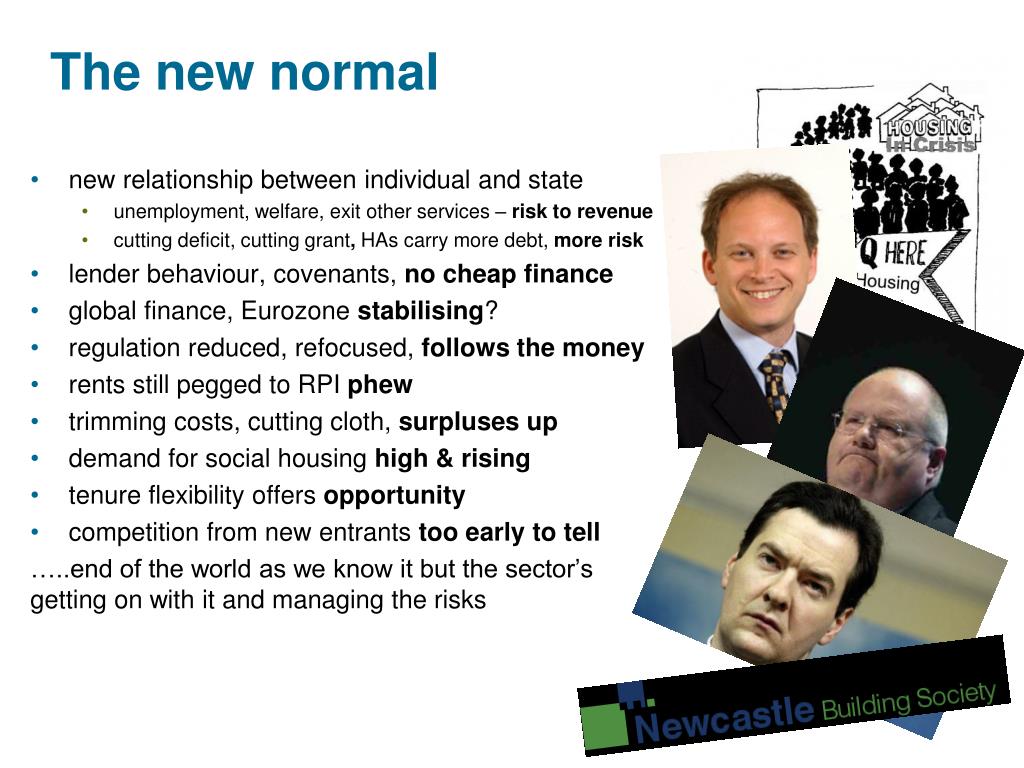
  1. The new normal • new relationship between individual and state • unemployment, welfare, exit other services – risk to revenue • cutting deficit, cutting grant, HAs carry more debt, more risk • lender behaviour, covenants, no cheap finance • global finance, Eurozone stabilising? • regulation reduced, refocused, follows the money • rents still pegged to RPI phew • trimming costs, cutting cloth, surpluses up • demand for social housing high & rising • tenure flexibility offers opportunity • competition from new entrants too early to tell …..end of the world as we know it but the sector’s getting on with it and managing the risks

  2. VFM: business imperative • regulation takes its cue from new normal: • ‘lever’ to improve taxpayer’s return on embedded public £s • promotes active asset management, backed by tenure reform • but VFM standard has broader perspective • tension between existing & potential tenant? • social business imperative: VFM generates margin to keep delivering objectives • smaller HAs need a compelling value proposition and evidence to back it…… • ….customer focus, responsiveness, specialism, localism, health & well-being?

  3. What are they looking for?: economic regulation in practice integrated assessment based on 8 questions • understand operating environment? • appropriate strategic business plan? • financial plan? • risk management? • robust approach to VFM? • track record of achieving objectives? • transparent & accountable – challenge drives improvement? • effectively led and controlled?

  4. VFM standard: requirements • boards understand and deliver VFM across operations (people) and assets (property) • in the context of the provider’s purpose • mindful of stakeholder interests & 3 Es (includes benchmarking) • involves understanding the ‘return’ on all resources available, expressed in financial, social, environmental & (service quality) terms • annually self-assess VFM & make it publicly available • VFM was about the cost & performance of services but this is wider – the whole business • reality check – are we really talking about business effectiveness here?

  5. VFM standard: implications • as a basis for active regulation – intrusive? • as a set of (voluntary) principles to ensure (social) business effectiveness - good practice? • should herald genuine board engagementin strategic business planning: • boards define VFM (business effectiveness) in their own image • essential to assert a clear vision of what they value (are in business for) • taking account of the value perspective of different stakeholders • more strategic debate about running the business • total VFM = bigger picture - forces challenge of previous ‘givens’ • the right activity or product mix to meet business objectives, eg social rents, care, affordable homes, services, regeneration…….tenure fits here • the right resource allocation between activities

  6. VFM standard: implications • appetite for risk – a clear position • understand which opportunities you go for • understand the business case • the right housing assets (in the right places) • the right service delivery system • efficient & effective service delivery • the right information to make business decisions – includes systems for capturing investment & operational costs & measuring the success of that investment • board competence - skills to provide strategic leadership, challenge & ask the right questions • requires investment of time – on strategic business issues and in skills development